All About EZ2

ANALYZING EXTREME ZEEN 2

ABOUT “AT THE OPERA”


“At the Opera” in EZ2 is a cut-up multidimensional short story inspired by the innovations of avant-garde pioneers William Burroughs and Kathy Acker– but also by the editing techniques of pop music (sampling) and cinema (montage). The presumptuous goal: to create a literary collage, using public domain writing by several of the greatest novelists who ever lived.

ABOUT THE FICTION

The three other main fiction works are subtly dystopian– subliminally speculative– about where our world is now, and where it’s headed.

ABOUT THE POETRY

The poems in EZ2 were chosen specifically either for their ability to comment on an adjacent story (“Common Note” by John Zedolik commenting on “Care” by Sam Paget), OR for their ability to be part of a word-and-design fusion, where the poem is not simply accompanied by an illustration or design, but fuses with it.

THE ANALOG EXPERIENCE

Extreme Zeen 2 is the ultimate in analog literary experience, presenting words and colors which “pop” off the page and cannot be duplicated on any digital electronic screen.

THE NEW POP LIT MISSION

The New Pop Lit mission is to create publications which can engage all segments of the population– with words and presentations that are fun, stimulating, and thought-provoking. Not off-putting text-dense books, but instead, inviting attractive zeens.

XXXX

The Story of Extreme Zeen

BIRTH OF A PUBLICATION

THE STORY begins during my zine-making days in the early 2000s, when I lived in Center City in the hectic town of Philadelphia, walking through a labyrinth of narrow streets to a tiny, out-of-the-way copy shop run by an aging hippie-type guy. Tall and thin, with a graying ponytail and a slow vibe to him. Occasionally I’d run off copies of my then-zine, New Philistine, on the self-serve copier near the front window. 

When I finished I’d give the man a roughly accurate count of how many sheets I’d copied, and he’d tell me a price off the top of his head, invariably lower than it should’ve been. Maybe because he had several zinesters as customers and appreciated what we were doing.

On this particular afternoon the proprietor motioned me toward the back room where he did larger print jobs. He showed me one of his art printers. He also revealed a few limited edition zines printed for a friend of his, and a special kind of paper made by a small specialty house in ______. (The name of a state.) I remembered the name of the little company.

“This is the best thickness and weight,” he explained. “Can print on both sides even with jobs that use a lot of ink, yet it’s light enough to use as pages in a zine. Very flexible, not stiff like standard photo paper. And look at those colors! They jump off the page. Synergy between ink, paper, and printer.”

With that comment he shook his head.

“Kids today have started making e-zines. E-zines! Zines on computer screens. Electronic dots. Turn off the screen and they vanish. Putting me out of business. They have their attributes, but they’ll never match this for quality. For artistic experience.”

We walked back to the front. I thanked him for the information and collected the sheets of my modest newsletter. Before I stepped outside I saw the man shuffling again to the back room, holding in his hand the specialty paper.

When I passed by the shop a couple months later, it’d closed.

XXX

The pandemic lockdown hit in March 2020, and as a retail job I’d lined up for myself fell through, I decided to put the extra time I had to use. To create, as I’d long planned to do, an upscale, high-quality version of a zine. A “zeen.”

I already had the right art printer, and with some difficulty located the specialty paper house located in ______. They stocked the perfect-weight paper for my project. I ordered it, as well as yellow paper of a particular weight I’d found to be also effective. 

But what would the new “zeen” look like? What would it be called?

My graphic design skills were yet primitive, but I had two assets to compensate for that: a pair of spectacular images my wife Kathleen Marie Crane had rediscovered when rearranging boxes of memorabilia from her days as a punk model in downriver Detroit. One, an edgy photo of herself with platinum blonde hair. When developed, black dots had appeared around the edges of the large photograph, which gave it a decidedly otherworldly effect. That’d be the cover.

The other image was a watercolor she’d painted called “Lucy in the Sky,” inspired by the famous Beatles song. The painting was of a large blue psychedelic eye. We’d put a copy of that at the center of the zeen, so the pages fell open naturally to a view of the hypnotic image.

Copied on the specialty paper, the painting became truly spectacular.

We both wrote stories for the zeen (the plot for mine provided by KMC), and solicited work from several talented writers we’d worked with in the past– one of them Philadelphian Frank D. Walsh, best undiscovered poet on the planet.

What to name the issue?

We came up with Extreme Zeen, for extreme design.

The zeen, though a bit crude, contained stunning visual effects enabled by the analog artistic synthesis described to me years past. Extreme Zeen was the first of several New Pop Lit print zeens. With each one we learned more about design and art.

NOW we’ve released Extreme Zeen 2— culmination of that knowledge, containing a synthesis not just of image and medium, but of words and art. You need to order a copy to know what I’m talking about. Available at our POP SHOP.

-Karl Wenclas 

Why Piero Scaruffi Is Wrong

A NOTE ON POP MUSIC AND THE BEATLES

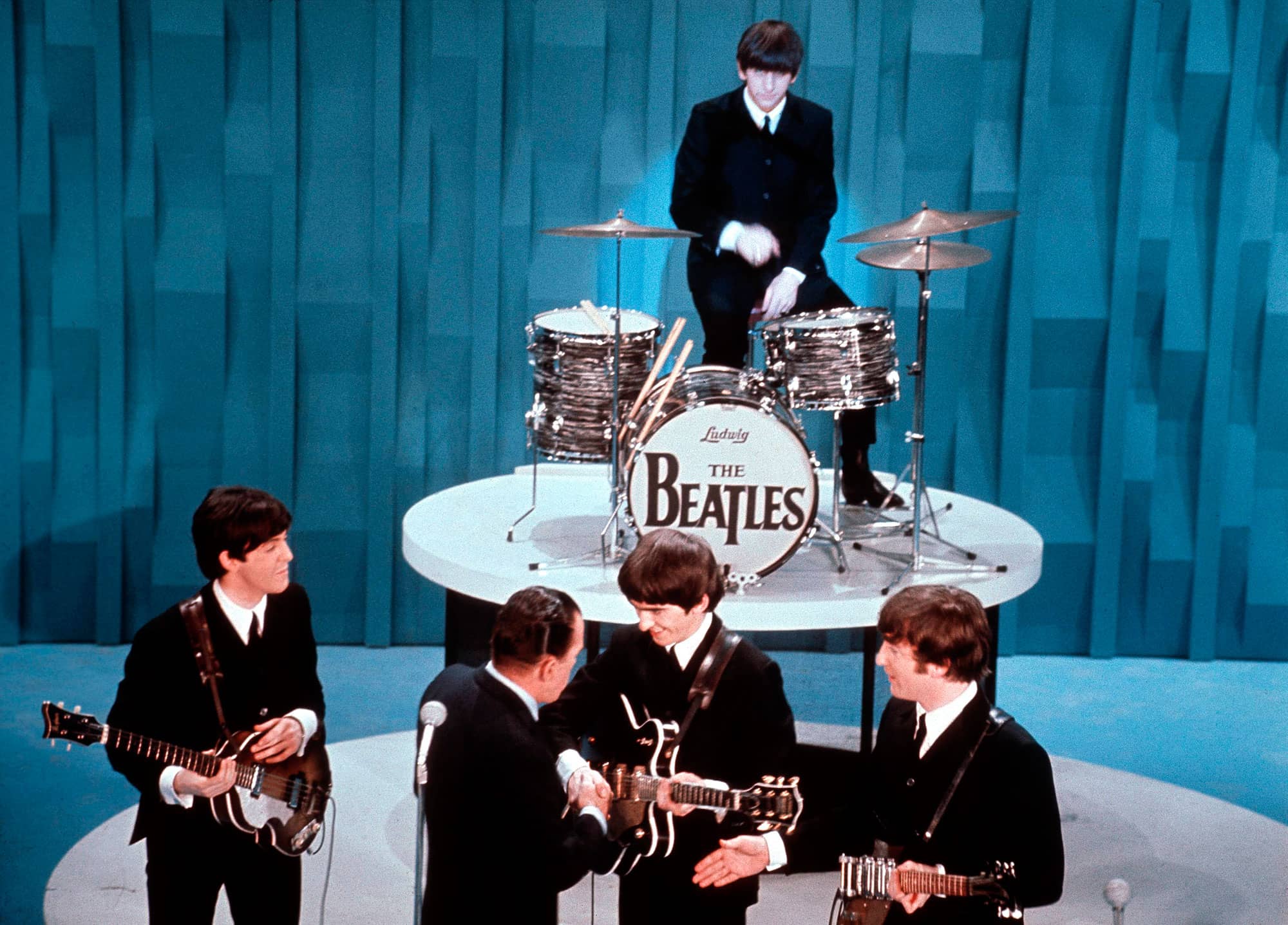
Beatles 1964.

The fact that so many books still name the Beatles “the greatest or most significant or most influential” rock band ever only tells you how far rock music still is from becoming a serious art.

This is the opening sentence to Piero Scaruffi’s famous rant about the Beatles– which can be read in its entirety here.

Scaruffi’s article has been endlessly cited, quoted, and referred to. The kicker is we can see from the very first sentence that he’s operating under a misconception of what rock music is, was, and was intended to be– likely because he looked at the phenomenon retrospectively, through layers of rock music criticism built up between the years of 1964 (the time of U.S. Beatlemania) and 1999, the year Scaruffi wrote his essay.

What he misses completely– like a baseball player striking out–

— is that rock n’ roll music from the start was a popular-not-“serious” art. Like its antecedents, rhythm and blues and country music, it was music of and from the lower classes. This includes the low-rent hustlers who recorded it, promoted it and popularized it, from the Chess brothers to Sam Phillips to Alan Freed to Colonel Parker to Dick Clark to Berry Gordy Jr. The only people who took it “seriously” were members of its audience.

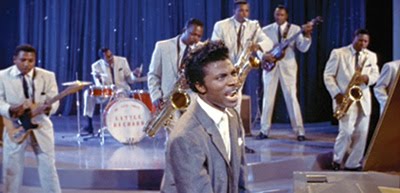
One can use numerous examples to illustrate this. Among them are the movies made to capitalize on what nearly all critics and tastemakers believed to be a temporary fad. For instance, “The Girl Can’t Help It,” starring buxom Jayne Mansfield and featuring Little Richard and other rock n’ roll stars.

Or, notice this sequence from the Elvis movie “Jailhouse Rock,” when Presley encounters a group of academics.

The entire point of rock music in its formative stage was that it was not in any way intellectual. It stirred the emotions and senses, was beyond analysis.

This was the situation when Beatlemania broke upon England, the United States, and the world. The Beatles’ appeal was aural and visual, direct and immediate, including their unique look. “Well, but they’re not serious artists!” hopeless reactionaries upset at their enormous popularity cried at the time.

Was rock n’ roll widely heard on college campuses before the Beatles broke big?

NO! College kids listened to jazz, classical, Broadway show tunes, or, increasingly, folk music from the likes of Pete Seeger, the Kingston Trio, Peter Paul and Mary, Joan Baez, and a fledgling songwriter named Bob Dylan.

As Scaruffi mentions, there was nascent activism at colleges in the early 1960s, but it centered musically around folk, not rock. The protest song became a cliche– “Where Have All the Flowers Gone,” “Little Boxes,” “Blowin in the Wind,” “What Did You Learn at School Today?” and so on. They were serious alright– but in no sense were they, or did they, rock.

Pete Seeger in 1964.

A good way to judge the musical environment in the United States into which the Beatles arrived– to see what music was taken “seriously”– is to read the list of Grammy Award nominations for the year 1964. Interesting– or comical.

ROCK GOES MIDDLE CLASS

What changed?

First, the massive popularity of the Beatles, which converted entire social classes and age groups to the rock music cause.

Bob Dylan at Newport, 1965.

Second, on July 25th in 1965, Bob Dylan “went electric” at the Newport Folk Festival, which outraged a significant portion of the audience as well as fellow performers, including Pete Seeger. Dylan in essence converted from folk to rock– and brought intellectuals and pseudo-intellectuals along with him. (To be fair, the prod for this conversion was the April 1965 release of a rock cover version by the Byrds of Dylan’s “Mr. Tambourine Man,” which became a monster hit, reaching #1 on the Billboard top singles list.)

It was only after bourgeois acceptance of rock n’ roll that rock criticism came into being– and “rock” displaced “rock and roll” as accepted terminology for the genre.

In sum, rock music was wholly the creation of the lower classes, first in America, then in Britain. The Beatles themselves were working class, from the rough seaport city of Liverpool. “Serious” intellectuals– not unlike Mr. Scaruffi– appropriated the genre, some ten-plus years after its birth in the U.S., and made it their own. In so doing, they made it more pretentious and overblown– rock musicians taking what had been quick entertainment all too seriously. Which in turn led to the creation of punk music in the 1970s to burst that bubble of snobby pomposity.

XXXXXXX

Karl Wenclas for New Pop Lit News

What’s New at New Pop Lit?

NEW LITERARY IDEAS DEPARTMENT

What’s new? Quite a lot actually.

First ,we have our newest feature story, the excellent “Sorry For Your Loss” by Greg Golley.

We have a brand new book review of a new volume of short stories by Emma Duffy-Comparone, Love Like That.

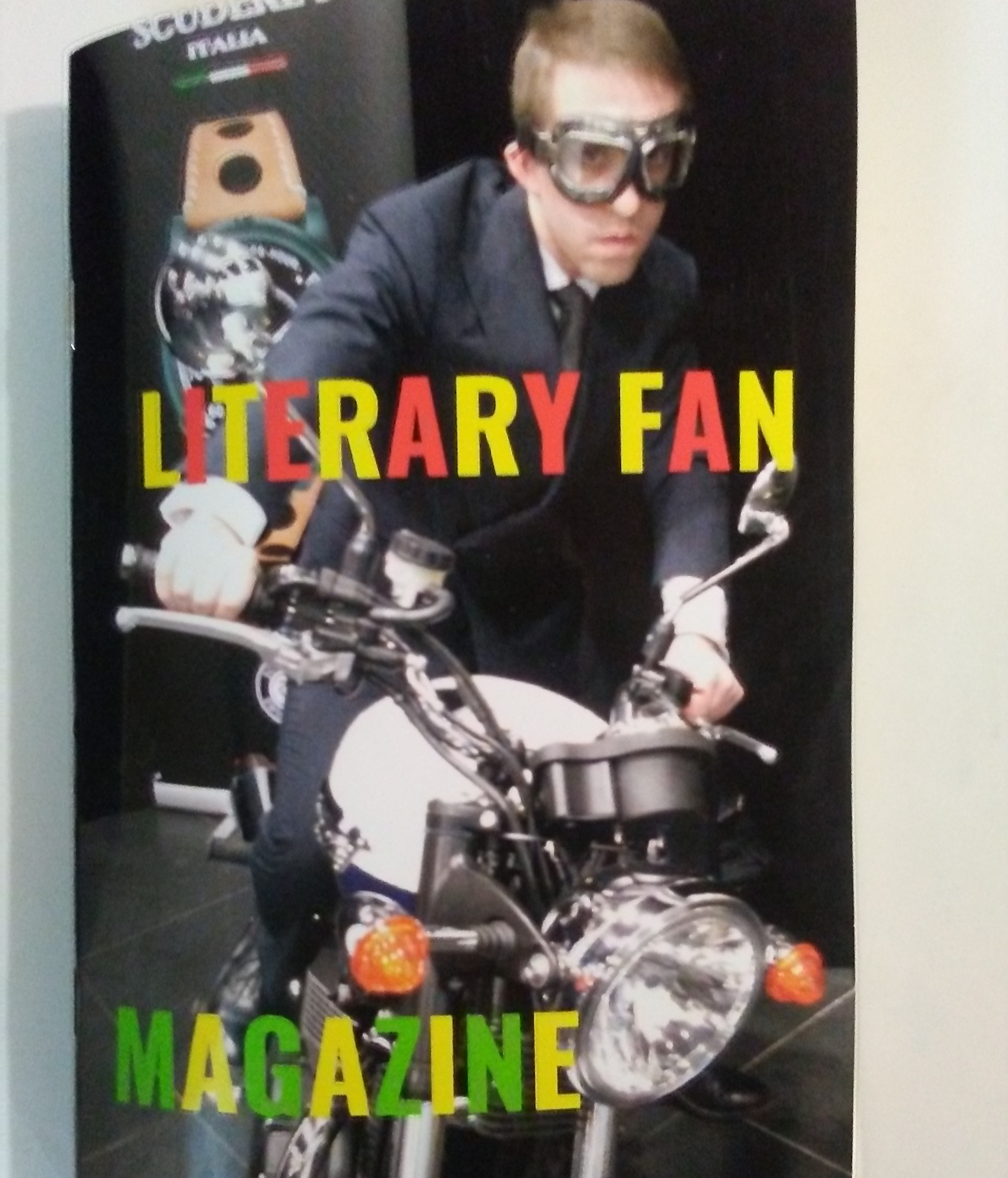
AND!!! we have as of a few weeks ago a new print-zeen on sale exclusively at our POP SHOP, Literary Fan Magazine. The ultimate fanzine/literary journal hybrid.

Please check all of it out. We’re the future of literature, though not everyone realizes it yet.

<<<<>>>>

The Red Shoes and the Hunger for Beauty and Art

REFLECTIONS ON THE START OF 2021

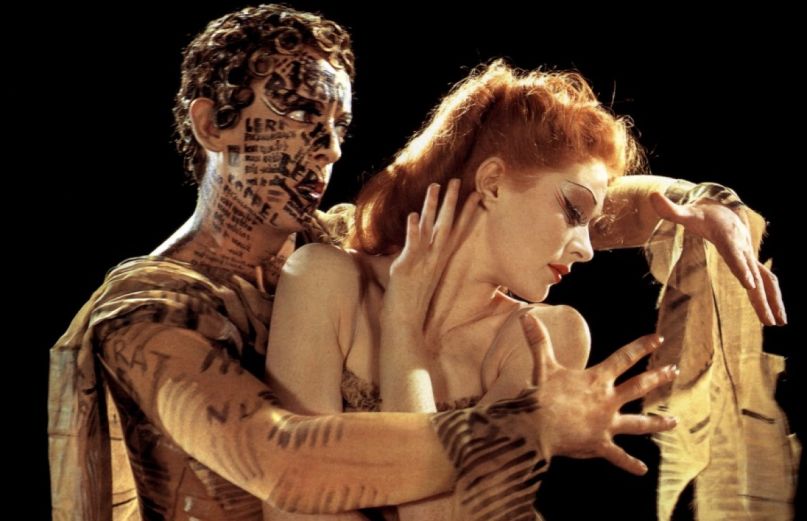
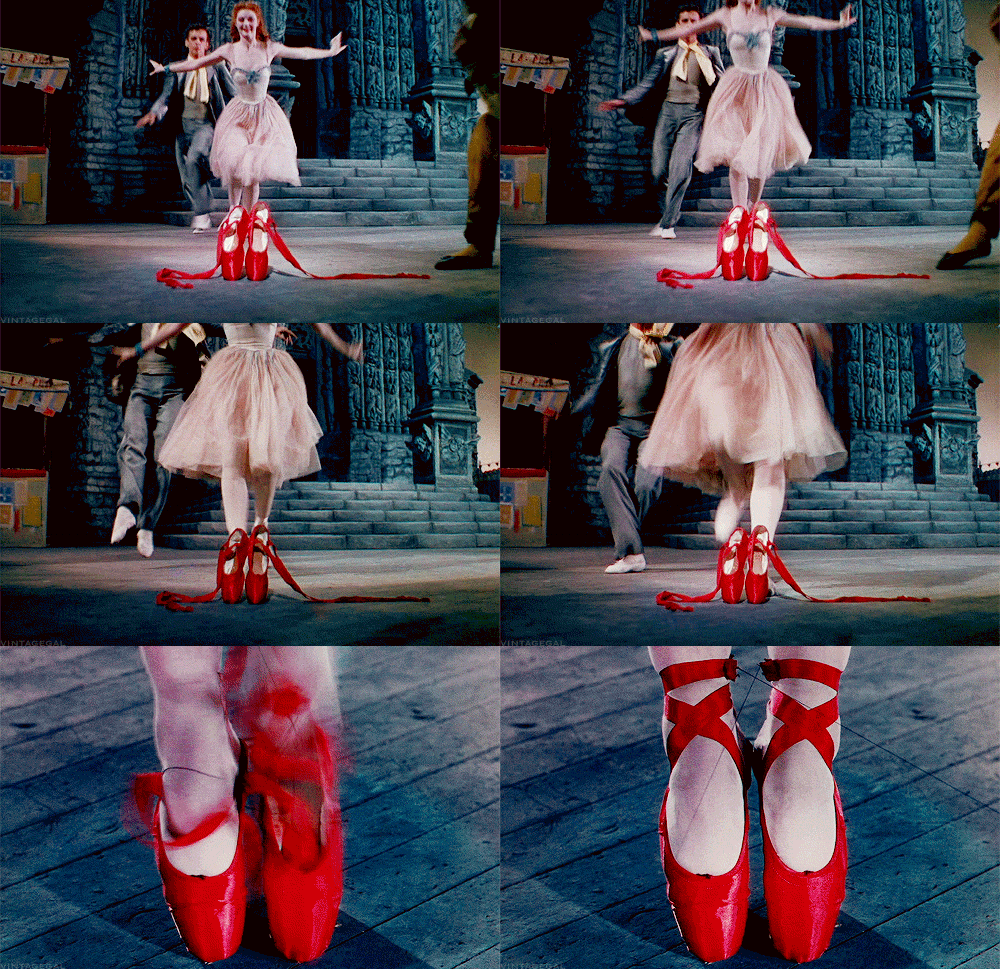
In 1948 when the film “The Red Shoes” was made, much of Great Britain was still in ruins, the country near bankruptcy, rationing in place. The population existed in what was by all accounts a gray, dreary world. This was the context for the movie’s opening scene when a crowd of college students eagerly rush up the stairs of Covent Garden to the cheap seats– there to imbibe the wonders and beauties of art. To receive an assault on the senses of color, costumes, scenery and music.

Filmed in glorious three-strip Technicolor, “The Red Shoes” is a tribute to beauty and magic in art. An ideal which has been eroded and lost over the ensuing decades, so the culture now is devoted to death, darkness, and zombies– to grovelling in the mud and saturating itself in the worst of mankind and society, instead of the best. The past year of gloom and lockdowns accentuated this trend, but didn’t create it. Darkness exhibits itself even in the literary world. Perhaps there most of all.

STYLES OF LITERARY ART

1.) Popular Genre. The dominant style according to sales and number of writers (given the number of ebook authors who adopt this style). Artistically it ranks at the bottom, because it’s unoriginal– generic– by definition. Imitations of imitations. To be artistically relevant, the style and its various genres need to change.

2.) Bureaucratic. The most admired style by both writers and the culture’s regulators of writers. This has three subcategories:

a.) Literary. The product of MFA writing professors and programs. It has itself become generic, manifested by emphasis on the well-written sentence and which includes an unselective mass of description and details.

b.) Postmodern. Taking literary writing one step further, with the added pretensions not so much of intelligence but intellectualism.

c.) Transgressive. This takes things one step further yet. Like postmodern writing, but darker, more negative and more solipsistic, with if anything even longer sentences and larger paragraphs. To break the hypnotic run of words is breaking the incantation of incoherent murmurs– the rhythm more important than sense or thought. The style fits with the bleakness of lockdowns and hospitals. With the depressing world of now. We don’t need to worry about a coming New Dark Age. Culturally, we’re in it.

What the three subcategories have in common is making words the prime value. Like a bureaucrat cranking out edicts and regulations, the bureaucratic writer produces mass amounts of words. The writer is prioritized over the reader, like a bureaucrat giving priority not to the consumer or citizen, but the regulation, and behind that, the system– the accepted, acceptable way of doing things.

2.) Polemical/Political/Religious. The “novel with a purpose.” Works for which the theme or mission or ideology is of prime importance. A style much frowned upon with the onset of the Cold War after World War II. Examples can be found on the left and the right. Two of the better novels in this vein are The Octopus (1901) by Frank Norris, and The Fountainhead (1943) by Ayn Rand. Many current novels are written in a polemical style, with themes either of social justice or the climate, or both. As it’s a difficult style to master– the author has to either be balanced in viewpoint or go completely over the top– few are worth reading from the current crop.

3.) Art for Art’s Sake. Aestheticism– or, a romantic pursuit of beauty. More seen in 19th century poetry from the likes of John Keats and Percy Bysshe Shelley, but aspects of this style permeated many of the period’s novels. The works of Alexandre Dumas, for instance, among the plotting, pay homage to beauty and art. The best later example is F. Scott Fitzgerald, in his beautifully-written and controlled stories and novels, which express the tragically romantic– the pursuit of an ideal, a “green light” at the end of a dock. As in “The Red Shoes,” to live and die for beauty and art.

Any such art movement, thrust into the gray world of today, would give the shock of the new. That would be truly transgressive.

THE QUESTION

The question is: Which style of literature is most needed now?

<<<<>>>>

-Karl Wenclas for New Pop Lit NEWS

Art of the Movie Trailer

WHAT ARE THE REAL BEST MOVIE TRAILERS?

Search online for “The Best Movie Trailers of All Time” and most of the ensuing lists are examples of willful cultural ignorance– containing chiefly films of the 2000’s, and few movies made before 1994. It’s as if the media sites don’t believe the film industry existed before that time (roughly corresponding to their own lifespans). The dumbed-down feeding the dumbed-down. Cultural stupidity encouraging more cultural stupidity. Of the movies listed, most are of a piece: glorified music videos, with, instead of music, the same metallic “ca-ching!” similar to the irritating theme of the “Law and Order” television series. Or, no imagination.

Movie trailers at their best are an art unto themselves. At times as good or better than the films they’re promoting. Their purpose is simple: to be shown in movie theaters to encourage audience members to return to see another film. Which trailers over the years have best achieved this? (It’s not an accident that the best movie trailers are for what turned out to be blockbuster successes.)

With this in mind, here are my selections for best movie trailers. They’re not THE best trailers of all-time, but they’re certainly, artistically, five OF the best. In chronological order:

BEN-HUR (1959)

Note the emphasis on sound, AND the overlapping dialogue showing the film’s literate script while delineating the conflicts at stake. Also of course a requisite glimpse at the greatest action sequence in movie history (with no CGI), the chariot race:

Ben-Hur 1959

<<<<>>>>

PSYCHO (1960)

The trademark droll Alfred Hitchcock humor on display, as if introducing an episode of his TV series. Lulls you into thinking this will be an amusing flick. But is it? Watch all of it. Be aware of what Hitchcock is doing with the trailer: setting up the viewer in the same way a baseball pitcher uses change-ups to set up a batter. Variations in pace. The use of extreme contrast. Note also the Freudian-Jungian psychological break represented by his opening the curtain. A curtain to the subconscious, the unseen, but also a radical break with cinematic past. After this moment the art for good or ill would never be the same.

Psycho 1960

<<<<>>>>

WEST SIDE STORY (1961)

How will this trailer for a revival of the classic film compare with the one for the upcoming Stephen Speilberg remake? Not the best movie of 1961, but a box office hit time and again, in part due to its trailers.

West Side Story 1961

<<<<>>>>

BATMAN (1989)

Another prelude to a blockbuster, this trailer built up tremendous anticipation for the film, capturing Tim Burton’s gothic atmosphere as well as the perfection of the movie’s unusual (at the time) casting of Michael Keaton in the lead role. “I’m Batman.”

Batman 1989

<<<<>>>>

ONCE UPON A TIME IN . . . HOLLYWOOD (2019)

If the objective of a trailer is to get you back into the movie theater, this one sure worked with me. A perfect trailer for a very good movie.

Once Upon a Time in Hollywood 2019

Which one of these five movies, based on their trailers, would you most like to see in a movie theater?

<<<<>>>>

Karl Wenclas for New Pop Lit NEWS

How to Beat Amazon

OUR STRATEGY AGAINST MONOPOLY

c/o Jeff Spicer Getty Images

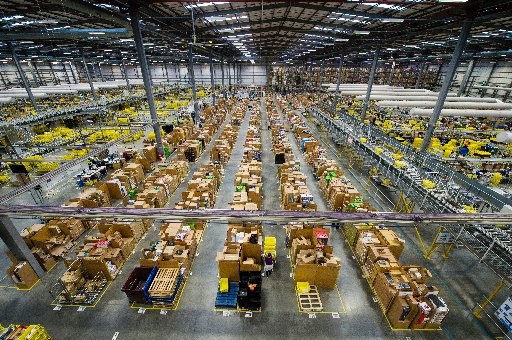
On-line seller Amazon has a current market value of $1.59 trillion and climbing. It’s the largest e-commerce company in the world and no one else is close. At the beginning of 2020 Amazon had over 30,000 delivery trucks and has put in an order with electric vehicle manufacturer Rivian for 100,000 more. Amazon currently has 175 enormous fulfillment centers in operation– 150 million square feet of space. If present trends continue, these numbers will increase. Quickly.

A CURRENT-DAY OCTOPUS

The Octopus is a 1901 novel by Frank Norris describing a railroad monopoly which was ruthlessly putting anyone who stood in its way of expansion and growing profits out of business. Sound familiar? In the novel (based upon actual events) a group of ranchers– self-employed businessmen– are utterly destroyed by the unfeeling monolith.

The good news is that 1901 was a sort of peak for the railroad monsters. A fledgling technology created and pushed by upstart entrepreneurs soon enough displaced the older technology with a more flexible alternative: the automobile.

Which means that even Amazon can be competed with– but it will take new ideas. A variety of them. We’ve come up with some of our own.

HOW THE MONSTER OPERATES

Amazon achieved its monopoly status, beginning with books, based on two basic ideas.

1.) Offer more choices than anyone else– ultimately, to offer every book ever published.

2.) Offer the products at a lower price than anyone else. Lower than anyone could possibly match.

The result has been a boon for the compulsive reader, but damaging to publishers– and devastating to writers.

WHY?

Because in these conditions it’s all but impossible for any new writer to stand out. For any single book to stand out.

At Barnes & Noble, the author was one out of 50,000. On Amazon, he’s one of millions.

Contrast this with a cultural entity at the beginning of its cycle. In the early days of hip-hop music in the late 70’s, how many prominent hip-hop recording artists were there? A handful?

Or take the rock n’ roll explosion in 1956. Again, fueled by a mere handful of stars who could create acceptable versions of the hybrid genre: Chuck Berry, Bill Haley, Little Richard, Elvis Presley– few others.

When the Beatles arrived in America in February 1964, they were the only British rock act in the vicinity, and stood out. Five years later, after every possible put-together group of mop-top Brits who could hold a guitar– in tune or not– had entered these shores, the value was not so much. It makes a huge difference if you’re one of one, or one of five– or one of 500,000.

In MFA programs across the U.S.A., students learn to craft fiction or poetry as well as– and indistinguishable from– that of ten thousand others. What, then, is the point?

THE GREAT LEVELLER

For books, Amazon has been like McDonald’s with hamburgers: The Great Leveller. Small-d democratic. Everyone can afford to eat hamburgers– and everyone now can afford to read any book. We’re all the same. In the process– with the commodification of the product– that product has been cheapened. Anyone now can read books but few are reading them. Books have lost their importance, their uniqueness, their value. They’re part of Amazon’s discount bin, rejects nobody wants.

DOING THE OPPOSITE

If Amazon’s strategy was to flood the market with books at rock-bottom prices, the antidote is to do the opposite, with a proviso.

Doing the opposite means offering a small number of authors, at a limited number of outlets. The proviso is the authors will need to have hyper-appealing personas– able to be “stars”– and the writing as well as the presentation will need to be notably different from anything else on offer. Attention-getting. The writing will need to be in a new style and genre, while the literary vehicles– books, if you will– will need to look like something other than a book. The literary upstart will need to offer–

THE SHOCK OF THE NEW

Which is why we put so much emphasis on innovation. Innovation of the art and the vehicle of the art.

A difficult task, with enormous potential payoff.

Our plan stands upon three basic ideas.

1.) Offer authentic artistic experience.

2.) Rebound away from the cheap.

3.) Make our products unique.

<<<<>>>>

In his quest to corner the market on books, Jeff Bezos cheapened the contents of those volumes: literature. Instead of a valued expression of the highest sentiments and ideals of mankind, literature became a bargain basement commodity, sold at discounts or given away. A race to the bottom. Our mission is to restore value to the literary art. To accomplish that will mean revamping the art, the way it’s presented, packaged, and marketed. All will need to be opposite to Amazon’s glorified bargain-basement discount shop.

The printed analog products– which we call zeens– we’ve created so far, three in number, are templates for those to follow. In the three zeens we express a variety of artistic ideas, attempt numerous effects, some partially successful, others more so. What we’re learning with our artistic and literary experiments will pay dividends in the future– on the road toward creating truly amazing literary journals.

To see those experiments, click on our POP SHOP. You may choose to order one or more of them– then open them when they arrive and fully see what we’re about.

<<<<<<<>>>>>>>

Nick Gallup versus George Saunders: Round Four

THE NEW POP LIT READING CHALLENGE CONTINUES

COMPARISONS OF TWO RECENT AMERICAN SHORT STORIES

A summary of rounds one through three:

Round One judging was done by William Rushing.

Round Two judging was done by Michael Maiello.

Round Three judging was done by Tom Ray.

This round– Round Four– is scored by Michael Kealan Moore.

Information on the Reading Challenge is here.

The Big Question: What do you think?

<<<<<<>>>>>>

“Two households, both alike in dignity.”

by Michael Kealan Moore

Gallup begins with thoughts and tones set by textual allusions and song lyrics—we are reminded of TV scripts, where, at times, writers rely heavily on the mood set by music; Netflix’s Pose for example. Jones’ Some Came Running brings a struggling writer and we lead into the mouth of “Just Another Silly Love Song” (JASLS) and enjoy the story of a slow to marry, air-cowboy. To say this is a “better reading experience” lays in the easily digested events, where the reader can immerse the self in the action and plot. The craft and construction is of professional stock as we go through the phases of the protagonist’s moves across a chessboard towards love and marriage. Joseph Campbell’s work comes to mind in both construction and characterization; Brown as the Mentor (also noted as “My mentor, General Brown”), the first date as “all is lost/dark night of the soul” etc. Further into the characters, they could be in any successful Film/TV romcom: blue-collar workers lookin’ for a better life, and love. The impact of JASLS shows us that it is not another silly love story but one with grace, action, adventure, grit, and American truth.

Ghoul” is a beast of a narrative which injects us into Postmodern tropes. This text takes time to simmer and cook in the mind, which adds to its genius—readers left to hack away stone to discover the diamonds underneath. We are reminded of Jean Baudrillard’s realms of the hyperreal in Saunders’ words and world, the characters working in a cursed Disneyland of sorts; this may well be the 13th floor of hell—but it is not, it is a possible America where one cannot speak the truth at times, otherwise they are kicked to death by their friends and lovers. We can summarize in Baudrillard’s words that this is a “desert of the real itself”. Is this a “better reading experience”? I will say it is a difficult read where the wheels of cognition are forced into motion, but ultimately we reread to fully comprehend. The craft involved in this text is above normal and within its construction we the readers are brought information through dialogue, notes/letters, body language, and action itself; where all scraps make the greater absurd whole. On the characters, I found them well crafted in that they are submerged in their own phenomenological experience of the hell they exist in—we are of course kicked back to Nineteen Eighty-Four, The Handmaid’s Tale, The Man in The High Castle, and Brave New World; particularly the human “savages” living out of reach. On the first reading the impact is entirely contrary to a second reading, the first leaving us somewhat confused—the second impact is sobering.

Both Ghoul and JASLS outperform each other in their respective styles; we can imagine fans of Postmodernism swooning over George Saunders while one who appreciates contemporary American writing will find joy in Nick Gallup’s words.

<<<<>>>>

Michael Kealan Moore holds a BA in Writing, English & Classics, an MA in Writing, and a number of qualifications in Psychoanalysis. He has worked in AI, Film/TV and Publishing for a number of years.

Ghoul versus Gallup: Round Three

ANOTHER ENTRY IN OUR READING CHALLENGE–

Not George Saunders. Different George. Same beard.

— ATTEMPTING TO ANSWER THE QUESTION: “WHICH STORY IS BETTER?”

We’ve been comparing two short stories. The first, “Ghoul,” is by renowned story writer George Saunders, author of the Booker Prize-winning novel Lincoln in The Bardo. (Bardo, not Beardo.) The second, “Just Another Silly Love Song,” was published by us and is by lesser known fictionist Nick Gallup.

Round One analysis of the story was done by William Rushing.

Round Two analysis was done by Michael Maiello.

Information on the Reading Challenge is here.

Our newest review of the two stories is by Tom Ray

<<<<>>>>

A REVIEW

by Tom Ray

“Just Another Silly Love Song” tells the story of the relationship between two individuals, Tyler and Roxie. “Ghoul” tells the story of a world divorced from our own reality, with the relationship between Brian and Amy being just one illustration of the relationship between individuals and society as a whole.

The characters in “Love Song” are realistic. We don’t know if Tyler loved his mother or if Roxie has daddy issues. However, thanks to narrator Tyler’s self-aware reflections as a mature man looking back, we know he was a typical late 20th-century man, obsessed with sex, concerned with proving his masculinity, yet not intimidated by a strong, intelligent woman like Roxie. As a woman of that era, Roxie is not afraid to show her independence, and will not define herself in terms of a male partner. On the other hand, she is attracted to a strong man who proves himself, as Tyler does, to be more than a macho stereotype.

The protagonist in “Ghoul” is also a young man. His reactions to events are how I imagine a young man in such a bizarre world would react, fearful of the consequences of breaking the authoritarian rules. All of the other characters, though, have no depth. They are cartoon characters put there to show how this crazy regime impacts Brian.

A lot of the humor in “Love Song” is self-deprecating, as the narrator recognizes his own foibles as a typical young man who got his life tips from reading Playboy. In “Ghoul” the narrator has no sense of humor, with unintended humor emerging in descriptions of the denizens of the underworld behaving like people working dull jobs in the real world.

Saunders is definitely the master in crafting this story. When Gallup’s story was first published in New Pop Lit I commented that he has a way of drawing the reader in. It was easy to draw me in like that, though, because the characters are realistic.

It was tougher for Saunders. I stuck with the tedious narrator, trying to figure out what the setting was. It seemed like a theme park, but as I read further it became obvious this was more sinister than that.

By the end of “Love Song” I was satisfied. The story is a little more sentimental than I usually care for, but it is light-hearted fun with wit. Toward the end of “Ghoul” I was able to say, “Oh, yeah, this is a metaphor; or is it an allegory, or a simile, or some other such thing that I stopped worrying about half a century ago in college English lit classes? Is it satire on life in the corporate world, or on religion? Who cares?” The corporate world sucks, we all know that, religion is bullshit, we’ve all heard that. “Ghoul” doesn’t say anything new on those subjects in an interesting way, and the tedium I felt in the first few pages returned in the last few. Not my cup of oolong.

<<<<>>>>

Tom Ray is himself an accomplished, widely published short story writer. Among the stories he’s written for us is this one, “Service.”

Another Ghoul/Gallup Review!

GEORGE SAUNDERS VERSUS NICK GALLUP ROUND TWO

ANOTHER writer-reader has generously weighed in with a comparison of the two short stories available for analysis as part of our current Reading Challenge. Michael Maiello graces us with his perspective, in a short essay titled–

Ghouls and Fools for Love

by Michael Maiello

When George Saunders hits The New Yorker, I PDF the stories and keep them in a desktop folder marked “literature.” I’m a fan, the same way I’ve been a fan of David Foster Wallace, Kurt Vonnegut and so many others who have that slightly “off” worldview. A Saunders story, for me, is a little event.

Every new Saunders story benefits from context. He writes frequently about people trapped in a warped capitalism — killing and dying and lying in the service of awful jobs and guided by Byzantine rules. In Ghoul, co-workers compete to rat each other out for procedural violations and when one person’s guilt is established, their fellow employees kick them to death. The system is so warped that you can turn somebody in for their failure to turn you in for your own crimes. Ghoul presents us with a heightened reality that will seem familiar to any American worker, particularly those of us who have dealt with duplicitous employers. Ghoul recalls other Sanders stories, particularly from CivilWarLand in Bad Decline and Pastoralia. Soon, Saunders will release a book of essays about Russian short stories and I wonder if it will be Gogol who most interests him, or if he will surprise me with a fascination for a more naturalist Checkhov.

Ghoul is, for all its social commentary, a love story, perhaps in a dysfunctional vein of 1984. Just Another Silly Love Song by Nick Gallup is also a love story, set in a more recognizable society. With quick pace and heightened detail, Gallup brings us along for the rollicky ride of Tyler’s maturation. It’s not that he falls in love, though he does, it’s that falling in love remains a mystery to him even as we, accompanying him on the journey, get to see how Tyler achieves this by growing into a full person, able to think beyond his needs.

Whereas Saunders gives us oppressed losers who cannot overcome their circumstances, Gallup gives us hard-working people who can overcome themselves. The stories are so patently different in aim that I’ll punt on the question as to which is “better.”

In laying down its challenge for readers to review these two stories against each other, New Pop’s editors say they hold Gallup with the same esteem accorded to the widely celebrated Saunders. Cheers to that. We all know the artists who command the most attention are not necessarily the “best,” given the roles of luck and circumstance behind society’s discovery of any creative person. Those of us who think about these things, though we’re often counseled to try not to, can’t help but imagine that even so widely regarded a figure as Arthur Miller wrote “attention must be paid,” about himself as much as he wrote it for poor Willy Loman.

I salute New Pop Lit for asking the question, as it motivated me to read Gallup and I’m glad I did. I will even PDF his story and save it in that folder marked “literature,” right next to the Saunders.

<<>>

Thanks much to Michael Maiello for his review– and to William Rushing for the prior review.

NOW— is anyone else ready to step into the ring and take the George Saunders versus Nick Gallup Reading Challenge? If so, let us know!

<<<<>>>>