The Wise Men

American Masters: Plimpton! Starring George Plimpton as Himself

Who steered the direction of American literature after World War II?

Editors like George Plimpton, Robie Macauley, Reed Whittemore, Robert Silvers, and William Phillips. Men on a mission who, as much as they professed no artistic ideology, very much pushed an artistic ideology. They’d been formed by various factors, whether by privilege, or the war, or by disillusion with Communism. By 1950 all were Wilsonians out to save the world by making it “Safe for Democracy”– their own special internationalist version of democracy.

Literature was their tool– they fully believed in the importance of the art. Paris Review (like Encounter magazine in the UK) was founded as a cultural ambassador for Anglo-American liberal ideals– presenting an intellectual alternative to the twin totalitarianisms of fascism and Communism. Liberal Cold Warriors, these editors disdained– or had rejected– the populism of the American past. John Steinbeck and his kind were out. Henry James as the ideal cosmopolitan author was in.

wisemen3
For our cultural aristocrats, literature, to be safe, must never engage too strongly in ideas. As an editor at New York Review of Books told me in a note in the late 1990’s, characters must never serve as mouthpieces for ideas. George Plimpton told me essentially the same thing on the one occasion I met him, at a literary debate held at CBGB’s in 2001. To these people, burdened– as they saw it– with the task of preserving literature, a broad view of the world was considered dangerous. An Ayn Rand or Frank Norris wrote beyond their well-regulated lines.

Focus moved instead to the delicate sensibilities of the bourgeois self. American literature became gnostic: insular and solipsistic. Cleansed, nuanced, refined; denuded of its loud voice but also much of its energy. For prose: John Updike. For poetry: John Ashbery.  Aesthetics was not the only weapon. No longer could a writer appear off the street like Thomas Wolfe or Jack London and be taken seriously. Writing programs and markers of breeding ensured all who entered the Halls of Approval were thoroughly screened.

Did these men and their journals have influence? Tremendous influence. They understood the concept of leverage; that a publication with a readership of 10,000 could determine who did or did not receive a large book contract– chiefly because that small readership was powerful and elite.

The change in aesthetic direction made the wise men– as well as their sources of money– very happy. Literature came under the control not of the unpredictable American people, but of themselves. The Elect.
****

American Masters: Plimpton! Starring George Plimpton as Himself

The thing to know about these men and their journals is that the faces they showed the world were misleading. George Plimpton was a smiling bon-vivant but also much more than that. The notion that he didn’t know the source of Paris Review‘s original funding is an absurdity.

Likewise, New York Review of Books, founded by Robert Silvers and Barbara Epstein, postured for a long while as a radical Leftist publication– yet it was started with Random House money during a New York newspaper strike as a way for the giant book companies to advertise their new releases. It’s always been an extension of New York-based Big Corporate Publishing. Sophisticated PR for them, one might say.

In the New York literary world, nothing is ever as it seems.

The Lit Scene Now

typewriter

All sides represent contradictions, as American literature is in a state of flux and objective(?) observers such as ourselves wait for things to sort themselves out. For the moment, intellectual thought about all matters literary is polarized.

THE RIGHT
We pass over long-time conservative journals like Commentary and National Review, which are adjuncts of an internationally focused intellectual establishment based in Washington D.C. and New York. We’re talking about the new Right.

What is it? Can it be defined? We wait for someone to define it. There is new thought, new energy coming from that end of the spectrum. To us it seems a badly put-together Frankenstein monster; a contradictory amalgam of Nietzschean paganism and tradition-leaning Catholicism. Its origins are found in intellectual journals like Taki Mag, with writers ranging from libertarian to libertine to anarchist to all things. Hardly conservative– many have opened Pandora’s Box. The aesthetic attitude is often snobbish and effete, and as such, out of synch with the mass of populists who voted for Trump. The impact to date on the literary world of these writers is small.

THE LEFT
The energy on the Left comes from a spate of journals like Jacobin Mag, The Baffler, and n+1— along with at least one interesting new one which we’ll discuss at a later time. All espouse some variety of Marxism. All editors, writers, and interns of these journals are from real privilege. Are they the Left? A curious form of it. Their common origin point is the Ivy League. What the publications present in their essays, editorials, poetry and prose is the skewed “View from Harvard Yard.” The tops-down acceptable narrative from cogs and creators of the established machine. Each individual has paid dues within the current literary system. They’re artistic conformists in every aspect.

Today’s nobility, representing a tiny sliver of America, peering at the Unknown from their Brooklyn/Manhattan fortress. Living a 2017 variation of Margaret Mitchell’s Plantation Madness.

overseer
(Former overseer Jonas Wilkerson and “white trash” Emmy Slattery getting thrown off the Tara estate.)
Well-bred aristocrats united with loyal retainers of color against the Enemy: white populists of sketchy background who carry the potential to upset their flimsy Potemkin facade. That high and narrow construction of paste and plywood labelled “LITERATURE,” which they present as the legitimate article– when it’s clearly NOT.

To understand these journals and editors and the role they play in literary culture, one first has to understand their predecessors. We’ll examine those in our next post.


Who Controls Universities?

blackbloc

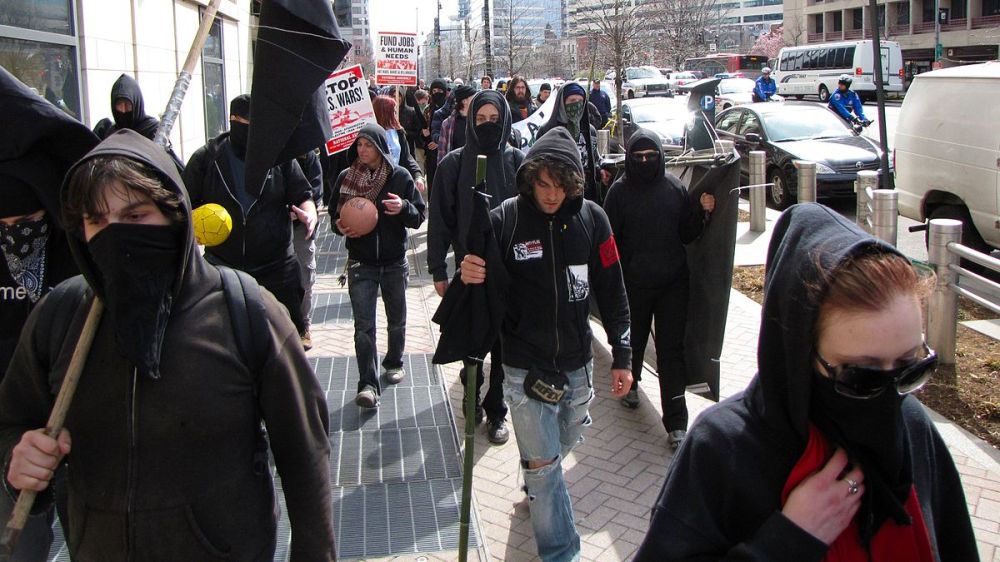
During times of upheaval, the students do. The programmed mob. Raging Id. An unleashed beast.

Dictators from Hitler to Castro to Pol Pot have known that students are the shock troops of totalitarianism.

Professors, those institutional markers of mediocrity, either stand aside, or rush to get in front of the parade. Administrators are as squeamish.

During times of protest, students feel their raging youth, their numbers and their idealism.

Attend one of those “Nutcracker” ballet matinees during the holidays and watch what happens when the children in attendance outnumber the adults– and they realize it. They take over the hall– shouting; screaming; running up and down the aisles.

We knew something was up in colleges when we had a table at the Allied Media Conference in Detroit two summers ago. I had sat at a table with a small press guy at the AMC in 2008. Back then it was a standard DIY zine-style event. Activists were there, sure. (Including myself.) But everyone was happy. The atmosphere, whatever your cause– if you had one– was harmonious. By 2015 the vibe had changed. No harmony. Instead: fragmentation. Each table with their own particular identity politics, from race to gender to abundant bodies– and everyone was angry.

Trump’s election didn’t create the anger. It set it off.

We sensed the irrational force hovering over the proceedings. Without question the self-righteous force is more dominant on college campuses now than in 2015. News events show this.

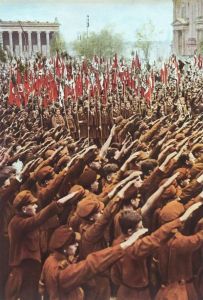
Mob power by its nature is intolerant. The question of “free speech” in the fight against injustice, to the youthful crowd on the side of right, is beyond irrelevant. Distasteful speech becomes an object of hate which must be steamrolled; cleansed away. Most people aren’t aware that Nazism itself was a youth movement which took over universities. Mob rule is always irrational, always fascistic, always totalitarian, no matter the flag of the moment it flies under.

hitleryouth

But who creates the mob–?