Why Ted Gioia Is Wrong

SAVING THE FUTURE OF LITERATURE


A POLEMIC

A RECENT Substack essay by cultural historian Ted Gioia, “The State of the Culture (2023),” has received a level of attention on social media the past two weeks. It’s an interesting analysis of the dilemma the arts face at the moment, where there’s far too many choices, too much supply for static demand. As Gioia states: “The metrics for our culture have never been. . . well, they’ve never been larger.” And: “Our culture is one of abundance and instantaneous gratification . . . Never before has so much culture been available to so many at such little cost.” The problem amid this abundance, Gioia says– for literature in particular– is a dwindling audience.

In his analysis of the situation Ted Gioia is undeniably right. He’s also right that the demand for writing– for books and literature– needs to greatly expand. Where’s he’s wrong is in his prescription for how to accomplish that.

His tried-and-failed solution is education. More and better education! “– let’s focus our efforts on creating a discerning audience for these offerings.” Audience development and institutional outreach– geared toward bringing good writing (and music and painting) to the masses instead of the usual large conglomerate offerings of generic pop music, big-budget CGI Marvel movies, and predictably bland mass market genre fiction.

The problem with Ted Gioia’s solution is it doesn’t work. Music education has been a part of public schools for at least seventy years. Billions have been spent by nonprofits and universities on training skilled new musicians while promoting appreciation of the art. You want outreach? A huge portion of any major orchestra’s budget is spent on outreach, through education programs in schools and at the orchestra’s facilities itself. I’ve worked as a salesman for a major orchestra (and other arts organizations), and part of my job was simple outreach. Letting the public know this art was there.


What’s been the result? Classical music, which circa 1955 accounted for 20% of the record-buying market, is currently down to 1%. Jazz, Broadway cast albums, and other forms of “serious” music are faring no better.

The situation is little different for literature. Despite hundreds of writing programs throughout the country churning out many thousands of well-trained writers, the literary art has never been more culturally marginalized and socially irrelevant than now. The Big Five book conglomerates don’t have a clue how to excite the general public, and neither do college professors and literary critics, most of whom bemoan the decline of “serious reading.”

THE SOLUTION

The preferred solution, in our eyes, is a completely revamped art, which the New Pop Lit project is about. Creating new kinds of short stories (once the most popular American art form), which can grab the reader from the first lines and never let go, and at the same time, be topical and relevant and maybe polemical but in all aspects engaged with the world and the lives of those who aren’t reading much of anything. This will include more striking-looking print vehicles than books with their predictably-formatted black-and-white texts accompanying linear single-viewpoint narratives. We’ve put forth some prototypes of alternatives, available at our POP SHOP.

The solution is all-new art, unlike anything yet seen, which demands to be bought. Art which can create true excitement among a lethargic, jaded public.

Is this possible? The music industry of the past offers a road map: the consolidation of strands of roots music into rock n roll, which via pure energy burst big-time onto the American cultural scene in the mid-1950s and pushed all other offerings to the sidelines. Rock was a demand-centered phenomenon, as record sales multiplied several times over during a twenty-year period, and vibrant music became an indispensable part of everyday life.

Could a similar cultural earthquake happen in the sleepy world of letters? If it can be imagined it can happen.

XXXXXXX

The Anti-A.I. Journal

THE A.I. DESTROYER


ANTITHESIS OF ARTIFICIALITY

Yes, the robot-busting publication expressive of human authenticity is already here. We anticipated the A.I. assault and the response needed– which is, affirmation of the skill, craft, intelligence, and good humor of human beings.

Put together by hand, produced in limited quantities, with emphasis on art and style, FUN POP POETRY SPECIAL EDITION is guaranteed to be Robot Free. All poems within were written by actual human beings.

Our zeens, as we call them, mark a return to the DIY authenticity of print zines, but taken to the next level of quality. The idea behind a zeen or zine is that you can hold it in your hand. With its tangible reality it’s something you can definitely NOT experience online. NOT processed by a dystopian megaconglomerate at far remove from individual artistry. With all of Walter Benjamin’s aura about it. NOT merely seen on a screen.

ZEENS are a step toward what we call post-A.I. culture: emphasis on real-world actuality. Like impressionist art– or punk rock– we seek to give people the “shock of the real.”

Here is your opportunity to fight the insanity. To rebel against the takeover of the culture and our minds by a handful of superplutocratic hyper-billionaire technological geeks. Help put ChatGPT and its like into the trashcan of history!

Order your authentic copy of Fun Pop Poetry SE at our POP SHOP today.

The Coming A.I. Literary World

UPSIDES AND DOWNSIDES OF ARTIFICIAL INTELLIGENCE


DILEMMAS AND NIGHTMARES


ARGUMENTS FOR A.I.

Use of the technology– ChatGPT and other such devices– like most new technologies, may be inevitable. It presents a shortcut for those who want to become writers, without having to learn the craft. Humans being what they are– a corrupt, opportunistic species– many wannabes will take the shortcut.

Could those who refuse the technology end up like old-school folk singers horrified when Bob Dylan “went electric” at the 1965 Newport Folk Festival by playing an electric guitar? Were many of the changes in rock music in the 1960s and 70s due simply to improved technology– from larger amplifiers to enhanced studio recording tricks to computer synthesizers?

Will the situation be similar for literature?

One of the strongest arguments for A.I. might become the perceived need not to be left behind.

ARGUMENTS AGAINST A.I.

So far, opponents to ChatGPT writings are focused on copyright and plagiarism issues– potentially enormous as the robotic brains steal phrases and sentences from any and every writer contained in their data base. But also potentially unpoliceable.

Other arguments against the use of A.I.:

A.) The literary world is already swamped with too many writers and too much writing, for much of anything to stand out from the mass. With A.I. bots creating poems, stories, and novels, that enormous mass of writing will multiply many times over. Prolific genre authors who previously produced three books a year, will now produce ten. Or thirty.

Given the law of supply and demand, the value of the individual writer– already low– will drop near zero.

B.) The technology will put thousands of employed writers, particularly essayists and journalists, out of work. On-staff people and freelancers both. Articles for a magazine or news site which used to be written by, say, twenty different writers, will now be handled by two. Expand this situation to include copyeditors, illustrators, and graphic designers. That’s a lot of pink slips.

I’ve joked that eventually Elon Musk and Jeff Bezos will run their entire plutocratic business empires with a few apps on their phone. This is becoming increasingly true.

C.) There’s the question of what increased reliance on devices to do thinking and creativity for us will do to our minds. Will our brains further atrophy as we advance away from a human-skills based society? This is a huge and hugely-important subject I’ll tackle in another post.

TOO MUCH TECHNOLOGY?

Will we reach a point of Too Much Technology in the arts, when the unique virtuoso creator rises again in appreciation and importance?


I think of the 2008 documentary, “It Might Get Loud,” about rock music guitarists Jimmy Page, Jack White, and The Edge from the band U2. The one of the three who relies the most on computer tricks and shortcuts for effects– The Edge– comes away from the documentary, at least for this viewer, by far the worst. Respect for him as an artist diminished, while appreciation of the other two true guitar virtuosos who rely on their hands and their own minds is enhanced.

Then again, in today’s world of pop music recording, the electric guitar itself has become a dinosaur.


<<<>>>

-Karl Wenclas for New Pop Lit News

The A.I. Challenge

CHATGPT AND THE FUTURE OF LITERATURE PART ONE


The sudden emergence of the ChatGPT Artificial Intelligence device has raised a host of questions about what effect it will have on writers, and on literature itself.

To attempt to plot out where we’re headed, one has to look at both extremes of reaction– not just to A.I., but to the contemporary world itself.

TRUE BELIEVERS

Over the past thirty years new technology has become a religion. Its entrepreneurs and advocates see it as a solution to all problems– and are blind to its many downsides. On social media, apologists for A.I. and for everything digital are everywhere. For them, the Internet IS the world.

In the arena of art and letters, the thrust of their arguments is that A.I. allows greater, or at least easier, creativity. Much time is spent defending against accusations of plagiarism and copyright violations– which are not the biggest issues with A.I. technology.

THE REFUSAL-TO-CHANGE CROWD

At the other extreme are writers and literary critics who can’t conceive of any change to the refined literary art they know and love. Their essays overflow bemoaning the dwindling status of “serious reading,” as they look back fondly at past “avant-garde” innovators such as Virginia Woolf, now safely dead.

How will they react to an invasion of ChatGPT novels into an already-saturated publishing market?

One can expect they not only won’t attempt to use the device (well, some of them will if the wind blows strongly in that direction), they also won’t try to change the art to put it more in step with a changing world– as a way to ward off the A.I. threat. Instead they’ll retreat further into their bunker and their canons of the past. In this instance, classical music is the model for what will happen.

THE FUTURE

What are the real pros and cons of A.I. technology applied to writing and literature? What’s the best strategy to follow: to embrace the technology, or find ways to defend against it? I’ll address these questions in a future post.

In the meantime, what do you think?

<<<>>>

-Karl Wenclas for New Pop Lit News

A Happiness Assault!


WITH CHRISTMAS and the other holidays upon us, we plan to finish the year with a campaign of pure happiness. Well needed when everyone seems stressed out and beaten down from the craziness of the world around us.

Our antidote to the harshness of the world comes in the form of a simple print publication: a Special Edition of our latest zeen, Fun Pop Poetry. Amazing words and colors to brighten up anyone’s day– from artists Monica Morgan and Alexandria Root, and poets Blixa Bel Grande, Scott Cannon, Emerson Dameron, Wred Fright, Courtenay Schembri Gray, Craig Kurtz, Christopher Landrum, Dan Nielsen, John D. Robinson, Joe Santi aka Tarzana Joe, Chrissi Sepe, Ellsworth B. Smith, Richard Stevenson, and S.F. Wright.

That’s a lot of talent in one slim and artsy poetry booklet!

Order your smile at our POP SHOP— red cover or yellow. Do it for yourself, (or purchase two and give one as a gift).

What Is the Literary Future?

THOUGHTS ON NATIONAL NOVEL WRITING MONTH


WHERE are we all of us– editors, writers, readers– headed as a literary community? An artistic community?

These are questions that will be addressed during our one-hour appearance at the Trenton Veterans Memorial Library, 2790 Westfield Road in Trenton, Michigan, for National Novel Writing Month aka NaNoWriMo. New Pop Lit editors Karl Wenclas and Kathleen M. Crane will be prepared to discuss all things literary.

THIS COMING SATURDAY, November 19, beginning at 2 pm.

All are welcome.

(You can register in advance at 734-676-9777.)

Thanks!

The Short Story As Pop Song

ANALYZING THE SHORT STORY FORM

OUR CURRENT feature story, “True Survivor” by Greg Jenkins, is a good example of how a short story can be artistically successful by following– unintentionally or not– techniques used to find success in the music business.

Foremost among them is the story’s opening, which does two things done by the famed British pop group the Beatles and others in order to stand out from the musical crowd.

1.) THE ATTENTION-GETTER

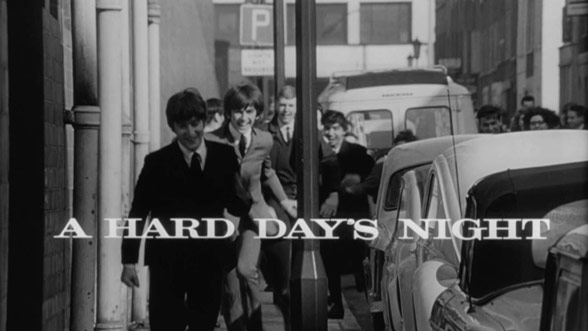
First, the attention-getting first note. First done by Ludwig van Beethoven to open his Third Symphony. A more recent example is the opening chord to “A Hard Day’s Night,” the title song to the Beatles’ first film. Think of how it must’ve sounded coming from large speakers in a movie theater, accompanied on a giant screen by an image of the four young musicians being chased down a Liverpool street. Attention: caught.

Greg Jenkins does the same thing with his story’s opening sentence, consisting of a single word, each letter capitalized: “SULLIVAN!”

2.) START WITH THE CHORUS

The second technique used by the Beatles was to in effect start the story with the chorus. Or, if it were fiction, in the middle of the narrative. Like opening in the middle of a song.

A famous example of this is one of the rock group’s first hits, “She Loves You.”

Which ensures opening with a bang. The Beatles did this again at least one other time, with similar success, with “Can’t Buy Me Love.”

What’s the goal? To grab the listener– or reader– by the collar, lift the person out of his or her chair and not let go until the artistic experience is over. Part of the creation of Beatlemania involved hitting the record buyer with immediate energy.

With a different art form, Greg Jenkins starts his story in the middle of the action, then goes back to explain what led to the conflict. (Jack London does the same thing with his classic short story, “Lost Face.”)

MORE POP

The most extreme musical example of this technique came a bit later in the frenzied history of the so-called British Invasion of America, in 1965, when Herman’s Hermits had a Number One hit by eliminating a song’s verses altogether– to a 1911 music hall ditty, “I’m Henry the Eighth, I Am”– and singing only the chorus, repeated three times. The result was not exactly artistic, but it was effective with the intended audience.

Could this be done with the short story– taking technique one step beyond? Stripping down a tale to its barest essentials and depending upon pure pop energy and enthusiasm to carry it?

We don’t know, but in our New Pop Lit LABS we’re not above trying every trick possible in our quest to reinvent literary forms, and in so doing enliven literature itself.

We also look for writers, like Greg Jenkins, who use innovative techniques. Know any others? Send them our way!

<<<>>>

-Karl Wenclas for New Pop Lit NEWS

Mid-Century Modern Movies

DESIGN VIBES

I’ve identified four movies which epitomize the apex of mid-century modern thought, style, and design. They are:

1.) Forbidden Planet (1956).

2.) North by Northwest (1959).

3.) Bye Bye Birdie (1963).

4.) Point Blank (1967).

The important point is that all of these films are visually designed to be ultra-modern, so the design itself enhances– or really, expresses– the story or the theme of the story, which are themselves ultra-modern.

1.) THEME: The future is us. ALTERNATE THEME: The future as nightmare.

2.) THEME: Ad man as quintessential American hero. SUB-THEME: Discovery and rescue of the soul mate.

3.) THEME: Pop culture as American Dream.

4.) THEME: The modern world as duplicitous hellscape.

Design is the quintessential American art. All four of these movies can be watched for their styles, clothing, colors, and designs.

-Karl Wenclas for New Pop Lit NEWS