Browsing Big Five Cultural Criticism
ON W. DAVID MARX’S BLANK SPACE
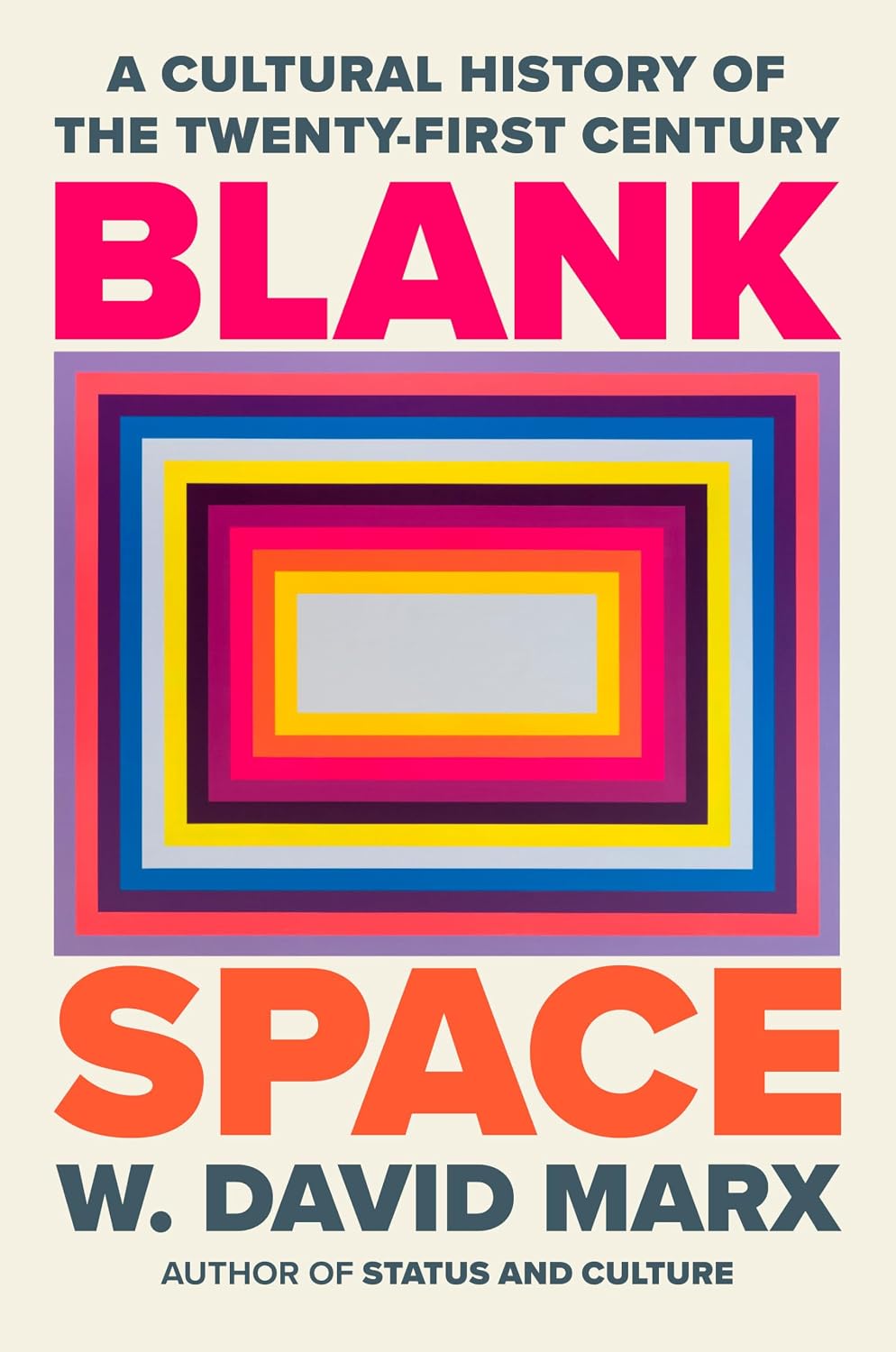
WHILE WAITING at the local library the other day for my wife to select a DVD movie to rent, I scanned through a book of cultural criticism I’d heard about, Blank Space, by W. David Marx, published by Penguin Group in November of 2025. I wasn’t about to check it out, as right now I have scant time to read, between learning new scripts for my remote day job, running the New Pop Lit site, and my own writing. I read most of the Introduction and last chapter and scanned the rest, so as a Reader’s Advisory, what follows isn’t a review, much less a fair one, only my quick impressions.
First off: 384 pages to tell us contemporary culture is a blank space? Which is pretty much all Marx is doing. Or, “today’s culture sucks.” You’re kidding me.
Of course, he has to endeavor to tell us why it sucks, to justify his book contract with Penguin. Excuse me, with one of Penguin’s 159 imprints, Viking. He needs to send them something. So W.D. zeroes in on a word called poptimism. One of those catch-all code words picked up by lazy critics as a short cut to impress the reader and express what they’re not supposed to like. “Poptimism.” A term invented in 2004. It didn’t have wide currency in 2004, or resonate with many people. If any. I was at the center of cultural activity then, continually in New York City, meeting journalists and debating with establishment writers, and I never heard anyone use the word. I’d not heard the term at all until recently. But Marx needs an explanation for what’s happened, so there you have it. Poptimism.
Establishment critics see the cultural world through books of cultural critics like W.D. Marx, who see the world ultimately through the prism of academe: “What did Fredric Jameson say?” Layers upon layers obscuring what was really happening, whether in the 1930s or 2000s or today. Fake history. All discussion remains within established parameters. Marx isn’t aware an underground exists, or has ever existed.
He has chapters about “Techno Optimism” and “Capitalist Surrealism,” discussing the anti-cultural. The artificial, not the organic. We’ve seen the organic the past few days with the example of Dolly Parton. One can trace her music through her Appalachian family’s singing together, including works from the Carter Family, or “In the Pines.” Actual culture. W.D. Marx is right in many of his criticisms of poptimism, but it’s not an either-or debate. It’s not a choice between only “poptimism” (product of giant corporations) and institutional elitism. Like the false choice handed us for many years: “kitsch” versus upper-class “avant-garde.” A big part of the book is spent discussing false alternatives. Notably, right-wing preppies in bow ties employed by Big Money tax shelter think tanks, funded by billionaires busily destroying this world in the name of profits and progress. The only alternative they offer is that they graduated from Yale instead of Harvard.
Here’s what gets me most about his book. On page 7 he says, “By 2001, upstarts looking to fight the establishment. . .” Then he gives the “alternative” as poptimism! Culture “became more accommodating to explicitly commercial culture.” Marx was living in New York City in 2001, but somehow missed the existence of the literary rebels of the Underground Literary Alliance, who received a ton of publicity throughout that year for their antics, revelations of lit-establishment corruption, and their presentation of a genuine, from-the-grassroots literary alternative to Big 5 top-down business as usual. One of the highlights of the ULA’s events was a debate at famed CBGB’s with George Plimpton and his Paris Review staff. Opposite poles. Populists versus elitists. The two groups could’ve been speaking different languages, about literature and about life. (I was there.)
“We need creators to disappear into their own worlds for awhile,” W.D. Marx says in his book. Which is what the DIY zine scene of the 1990s, offshoot of DIY music, was about. He celebrates “outsiders willing to create their own movements from scratch.” Which is exactly what the Underground Literary Alliance did.

At the end of the book, W.D. looks for a vanguard to get things going. “Restoring Cultural Invention.” Does he really believe cultural invention will come from his intended audience: programmed human robots indoctrinated by an hierarchical academy in a technocratic age? Though we can’t be too hard on him. He went from Harvard to Google(!) to Manhattan to Japan. His heart’s in the right place, if not his brain. What would he know about this nation’s hinterlands and the voices of the mass of its people? Those expressing their outrage now, as I write this. Those from whom any lasting change will come, as all cultural alternatives, 1930s through the 60s through the 90s have sprouted, real and organic.
-Karl Wenclas

