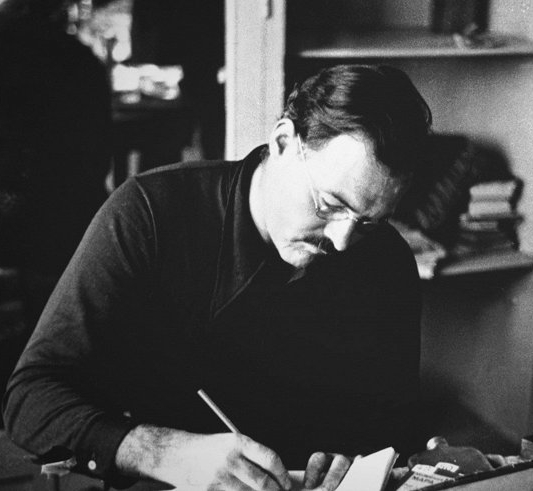
How Ernest Hemingway Reinvented the Literary Game

(image c/o Everett)

Achieving Artistic Breakthrough

Has Literature Failed the American People?

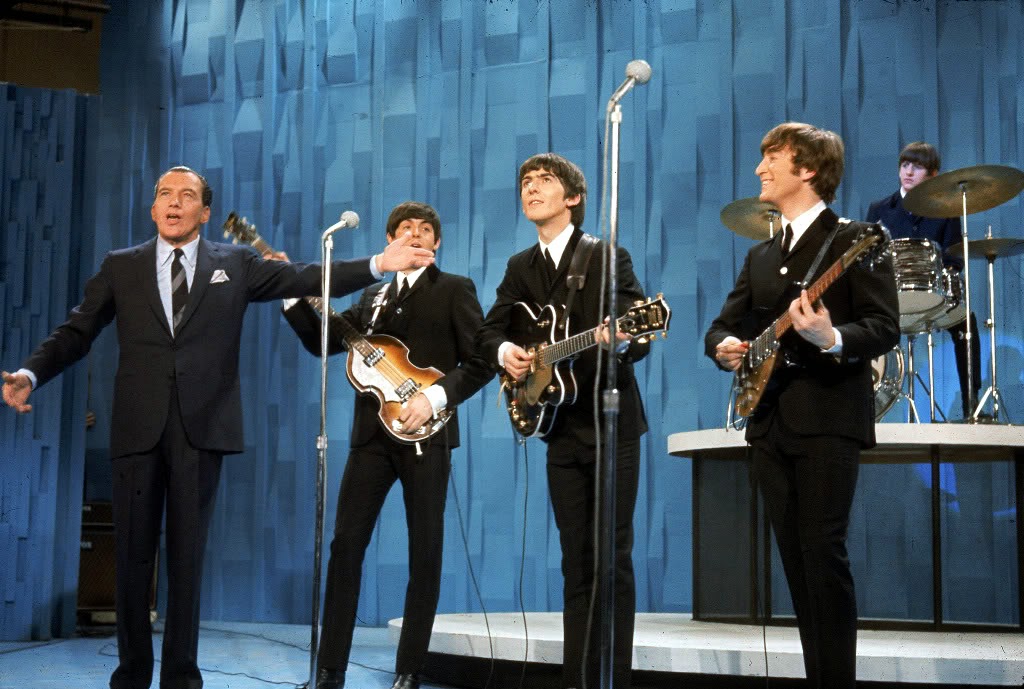
All About “The Loud Boys”

The Inside Game of AI

Shakespeare and Creativity

Shakespeare and friends at the Mermaid Tavern by John Faed

ONE THING to be noticed about the use of A.I. programs for writing, copyediting, and education is the way the programs enforce conformity and stifle creativity by forcing written language into an ever-narrower template of rules. Type something “wrong” in a document or email and the “correction” instantly appears. I’m sure most writers, especially new ones, immediately comply.

(The latest step in conformity is ChatGPT, which will do all your writing for you, by recycling lines and ideas from past writing– with not a shred of originality. We have a petition ongoing about that matter, which we suggest everyone read.)

Yet these processes, spawned by top-down systems, work contrary to the mode of operating of the greatest writer of them all, one William Shakespeare.

Stratford Will grew up in a time and place that was still largely an oral culture. Written communication was used first for legal documents, while the printing of books was strictly controlled and limited. Language was a verbal phenomenon, and that’s how people used it. Dictionaries had yet to be invented, while grammar was in a state of flux. Spelling was creative, to put it mildly– often used to give cues for how sentences were spoken— which words or syllables to emphasize, depending on context. Spoken language was the main thing– especially for Will and his colleagues in their acting company, as their art was a verbal, not written, art. Literature, for them, was a very different creature for them from what it is for us today.

In other words, it was a milieu designed for creativity. Everything about William Shakespeare’s life enhanced that freedom of creativity. Rules? What rules?! Shakespeare invented hundreds of words, often by turning nouns into verbs. (Today he’d be told, by a teacher or professor or bot, “You can’t do that!”) He was the son of a glovemaker, perhaps learned some of the trade himself, receiving the mental stimulation which comes from skilled manual labor. Also of course, he wasn’t just a writer, or just an actor, but more. Like his fellows, Will was a businessman, stagehand, salesman, and part everything else that went into the acting company’s productions. A jack-of-all-trades, or a “Johannes Factotum” as he was once scornfully described.

FINDING THE REAL SHAKESPEARE

Ironically, it’s the Stratfordian establishment itself which has perpetuated misconceptions of the man, his friends, and his times, in their effort to canonize him.

(Something similar happened with the Beats here in the USA. Free-wheeling fun-loving bohemians taking joy in words and art, they’ve been co-opted in total by a rigidly elitist literary establishment– canonized; or rather fossilized, preserved in amber and placed behind glass– though no one should dare write or behave, in this constipated world, too much like them. As evidenced by a protest at Columbia University back in 2006 by a performance troupe of which I happened to be part.)

The mistake academies make about Shakespeare’s poems and plays is treating them as artworks to be read– when they were created to be seen and heard. To be performed. Without that performance one can’t fully understand the plays or the men who created them.

To find the real William Shakespeare one has to read up on his friends and partners in the Lord Chamberlain’s Men acting company, started by working class carpenter, actor, and entrepreneur James Burbage and his two sons. The company was a collection of characters. My favorite might be Robert Armin, a goldsmith apprentice who was sent one day to collect a debt owed his master. Unable to collect it, he scrawled witty verses of complaint on the walls of the inn with chalk. Queen Elizabeth’s personal jester, Tarlton, noticed them and recruited young Armin into a different form of apprenticeship– one of acting, comedy, and playwrighting. (Note the suffix of “wright”: one who builds, repairs, or creates, such as a shipwright. The connection between skilled manual labor– dextrous work done with the hands– and literary creation.)

KEYS TO CREATIVITY AND ART


Vincent van Gogh’s artistic wonders were based on his ability to escape the systems of his day– to seek grounding in earthy reality. Here’s a quote from one of his letters to his brother Theo:

I wish those who mean well by me would understand that my actions proceed from a deep feeling and need for love, that recklessness and pride and indifference are not the springs that move the machine, and this step is a proof of my taking root at a low level on life’s way. I do not think I should do well in aiming at a higher station or in trying to change my character. I must have much more experience, I must learn still more, before I shall be ripe, but that is a question of time and perseverence.

(Interesting that Van Gogh’s emphasis on experience undoubtedly opened new neuropathways in his brain and gave him a stronger foundation of empathy and knowledge. On the path to genius.)

———————————–

We have more systems today than ever, enforcing conformity by regulating and controlling every aspect of our lives. The artist’s job is to throw off those shackles and escape those controls.

XXXX

Coming soon: The Burbage Spoken Word Prize

XXXX

-Karl Wenclas for New Pop Lit News

Prototypes

MAKING CREATIVE CHANGE PART V

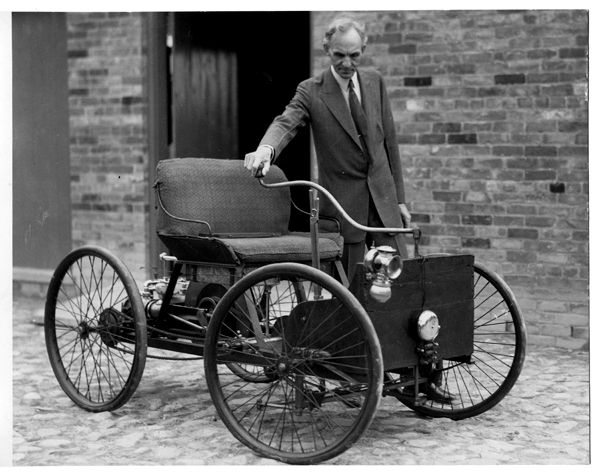
ONE OF the first steps in creating the New is development of a prototype. That which can hint at innovations to come. As Henry Ford did with his first prototype, an automobile constructed largely from bicycle parts.

A prototype is a demonstration model intended to serve two purposes:

1.) To show potentials of the design or concept.

2.) To reveal flaws when ideas become reality.

By definition a prototype is not a finished product, or the ultimate expression of the intended product. But it should point a direction– a new path for creators to follow.

Prototype of first Tesla Roadster c/o Tesla Motors.

We’ve developed prototypes of new kinds of literary journals (see them here). But we’re also working on what we call the multidimensional or “3-D” short story.

One of the simpler ones we’ve released to date is “The Perfect Candidate.” Note how the opening is intentionally disorienting– the idea to disorient readers then quickly reorient them. (“Where am I? Who’s speaking?”) The narrative in this one is linear– but the changing viewpoints allows the writer to hint at what he wants, obscure what he wants, and reveal what he wants.

The story is designed-– as designed as a modernist skyscraper or the layout of a glossy New York magazine. The goal: a more rounded version of reality. The idea behind this story, this prototype, is to point to the endless possibilities of the well-designed story.

THE NEXT STEP is looking upon the short story– or the nonfiction essay– as part of an entire aesthetic.

THE CHALLENGE

The objective is to put the literary world into a state of flux, where change becomes constant– the only way to diminish the built-in advantages of an institutionalized, monopolistic status quo. Then– to stand out among the innovators.

Timing is key, as it was for Henry Ford. No one remembers the other tinkerers and pioneer automobile innovators, the other hundred-or-so fledgling car companies in the first couple decades of the Twentieth Century.

No one will remember this project unless we achieve artistic breakthrough.

Three Kinds of Revolution

MAKING CREATIVE CHANGE PART III

1.

TRADITIONAL REVOLUTION. Thorough and swift destruction and replacement designed to demolish existing institutions and the System itself and replace them with all-new everything. See Robespierre and Lenin.

2.

GRADUAL REVOLUTION. Change within existing institutions and hierarchies, designed to capture them. Theodore Adorno and the Frankfurt School might exemplify this mode of thinking. Or were precursors of it, along with Antonio Gramsci.

3.

COMPETITIVE REVOLUTION. Competing with existing institutions using smaller, faster, more mobile and vastly more creative new organizations. Elon Musk’s various projects, as well as many popular DIY podcasts, fit this category.

CHANGE AGENTS

Currently we live in a world where Revolution Style #3 has pushed its way to the forefront. Upstarts everyplace. New ways of thinking pushed by what could be called change agents. The active molecules mentioned in Part I of this series.

Musk due to his penchant for publicity is at the forefront of such energized entities. Elon Musk has always been a huckster, combined with an arrogance unleavened by humility. (He’s yet to be knocked down hard by life.) His real strength lies in his ability to see weakness in established institutions, whether they be Boeing in aerospace, or General Motors and other legacy giants in the auto industry. The ability to observe “the best” and realize they can be taken down.

Elon Musk carries the ethos of the upstart– eager to topple complacent established kings and set himself up as new one.

In this quest, he relies on the doctrine of First Principles, which we’ll look at in the next installment of this series on change and how to make it.

-K.W.

Making Creative Change

PART I: WHAT WE’RE NOT TAUGHT

Few people see the world as it really is, because we’re not taught to see it that way: As conflict between the dynamic and the static. The active agent, and the acted upon.

Count Leo Tolstoy discussed this in his massive masterpiece novel War and Peace. Is history the product of great men– or of the movement of massive unseen forces? Or a combination of both?

In his discussion of Napoleon and the invasion of Russia, Tolstoy saw the great man as merely along for the ride, accompanying a wave of economic and social forces. Yet change as often as not, even in the instance cited, is a matter of the willful individual pushing and driving the merely passive: the static. The inertia of movement pushing the inertia of the unmoving. Force upon molecules. One dynamic individual disturbing all around itself, like a cue ball upsetting a rack of balls in a pool hall.

XXXX

CHANGE should be especially true in the arts, which are intended to be dynamic. In constant flux.

The question for writers is: Which side of the equation are you on?

If you’re not published by one of the Big Four Manhattan publishers, or a professor at a university, it makes little sense to be on the side of the static. Of the aesthetic status quo. (Unless you write and publish as a hobby, to impress relatives and friends. But if you want more– ?)

NEXT: “Teaching Gatsby.”

State of the Site 2022

NEW POP LIT ENTERS A NEW YEAR

THE BIG NEWS for the New Pop Lit project is our receiving a “Creators of Culture” grant from a wonderful Detroit-based arts organization named Culture Source. As near as we can determine, we qualified based on several criterion:

-Our EIC’s long history of promoting overlooked writers, notably in the 2000s with the Underground Literary Alliance.

-New Pop Lit’s focus on artistic innovation and design, including with our one-of-a-kind publications. “Craft publishing”: the idea to make our publications as creative and non-generic as possible.

-Our continued experimentation with literary form. This includes our behind-the-scenes effort to completely reinvent the short story, ongoing.

The starting point for everything we do is that the literary status quo isn’t good enough.

THE FUTURE

We’ll use the graciously-awarded funds not solely to keep this project operating (it’s been touch-and-go at times), but chiefly to discover and spotlight new writing and artistic talent, with more focus on talent in metro Detroit and environs.

Toward those ends, we’ll hold a contest or three, with monetary prizes.

The grant will also enable us to create more print publications. A portion of the award will be spent on necessary equipment and supplies. (Notably, paper and ink!)

The intelligent universe has conspired to keep us ongoing a while longer. As long as New Pop Lit lasts, we’ll aspire to achieve amazing arts breakthroughs– or at least one!

Stay informed via our Coming Soon page. Thanks.

XXX