Will Junot Diaz Survive?


THE BOSTON REVIEW CONTROVERSY CONTINUES

220px-JunotDíaz069

ART like the world is three-dimensional and should be approached three-dimensionally. A great novel then, ideally, should use multiple viewpoints. To understand an issue– as we’re trying to understand this issue– the critic or commentator should look at it from multiple angles.

Popova_Air_Man_Space

(“Air, Man, Space” by Lyubov Popova.)

YET on this issue of whether Junot Diaz is an abusive misogynist and whether he’s assaulted women and been insulting and patronizing and whether or not he should resign or be fired from the Boston Review, everyone is taking a side. Everyone wants a fast decision (even though there’s a lot of gray in the issue). “Yes! No! Guilty! Innocent!” Dueling mobs, only in this case it’s one mob, with a few deputies standing outside the jailhouse door with shotguns, guarding it like out of an old western movie.

Txrangers3

The mentality is binary. Which is curious, because Boston Review and its opponents stress their support of non-binary persons, but in no sense do they engage in non-binary thinking.

We’re conditioned to think in terms of two choices– Column A or Column B. The court system– protagonist versus antagonist; defense attorney against prosecutor, with no middle ground between them. Politics: red state or blue state. Either-or. Two choices at the ballot box. Which is your party? All-in either way, with no give-and-take. Black-white. Good guys or bad guys. The world as soccer field: choose your side.

IRONICALLY enough, the Boston Review plays this game as strongly as anybody. They present a one-track mindset.

The Boston Review editors know. They have the truth on every issue and are out advocating it– only this time the perceived truth is blowing up in their faces.
****

I LISTENED to the recorded exchange (starts 33:00) between Carmen Maria Machado– one of the main accusers– and Junot Diaz. It’s not an argument, not even a debate. Is Diaz condescending and arrogant? Possibly. The recording is like a modernist painting that the listener sees what he or she wants to see in it.

More interesting is the way Junot Diaz reaffirms his politically-correct stance throughout the talk– even before Machado enters into it. He takes the requisite swing against white supremacy. He mentions “masculine privilege” and “toxic misogyny.” “Sexism,” he says about a book, “is going to be implicit on every fuckin’ page.” He’s saying, “I’m on your side.” Shocked he must be that he’s on women’s side– so he proclaims– but they’re not necessarily on his.

The same holds true many times over for the chief editors at Boston Review, Deborah Chasman and Joshua Cohen. Every article takes a political stand, in the most progressive fashion. It might be the most progressive and politically-correct journal you will ever read. They’re against the cakeshop ruling, neoliberal market police, wealthy whites, and Elon Musk (that chic billionaire– boo!), and pro- California, Afrofuturism, and Planet Earth. Every base covered.

None of this surprising when you realize Joshua Cohen has taught political science at Stanford and MIT, or that his stated mission when taking over as editor in 1991 was to have the journal become more politically oriented, while retaining a profile in fiction and poetry.

The impression given when listening to the recorded Junot Diaz lecture, and studying the Boston Review website, is that literature has become thoroughly politicized. Politics is a major part of the Diaz recording– every question asked and answered comes through a political lens. The audience and Junot Diaz are presumed to be on the same side– indeed, everyone there is. That room for disagreement was found despite this becomes fascinating.

WHAT’S HAPPENING

Revolutions tend to eat their own, whether Danton and Robespierre in one instance, Zinoviev and Bukharin in another.

Stalin-Bukharin

Joshua Cohen and men like him spearheaded a cultural revolution in America. It began in the 1960’s and never stopped. At some point the original grass roots revolutionary impulse became co-opted and since it’s been stage-managed from above. Cohen himself is a graduate of both Yale and Harvard. Elite of the elite. Select of the select. His periodical Boston Review has the superstructure of MIT behind it, as well as this list of powerful individual and institutional donors. Joshua Cohen defines the term white patriarch. Now he finds the forces he helped unleash don’t always behave as he wants.

Arrogance? Of a sort, in that Joshua Cohen doesn’t seem to understand the rules of the game even though he helped create them. In other words, at some level, or many levels, the dispute is about power. Who’ll hold it within the tottering structure of established literature? Who should hold it?

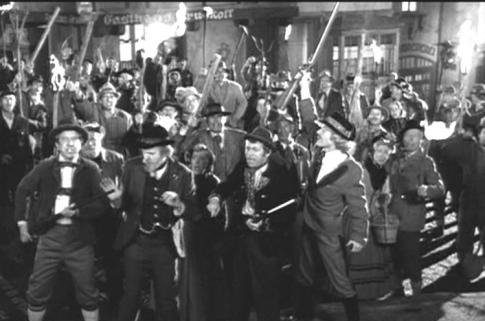
(The lynch mob marches down the street with rope and torches– “Where is he?”– Joshua Cohen at the front of it. “This way!” he shouts. A culprit is found and taken to the scaffold, rope put around his neck– he turns to face the crowd and Joshua Cohen finds to his shock and horror that the figure about to be lynched is him.)

Lynch-mob-2-e1525465690886

MORE TO COME

-Karl Wenclas

Are Comic Books Propaganda?

COMICSGATE EXAMINED

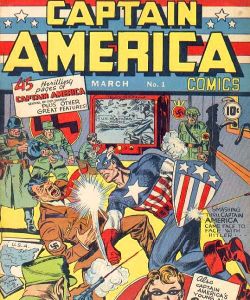
captainamerica1

HOW FAR should one take politics in art?

The question arises with the ongoing “comicsgate” controversy which has split the comic book publishing world. (Background on the issue is available here  and here. Debate has raged across the internet, especially on twitter, for weeks.

A point made by those on the social justice side of the issue is that superhero comics have always been political. Nazis in particular have been socked by superheroes for decades.

They’re right. Superhero comics have been political almost from the start. The kicker is they’ve been more than political. From World War II through the Cold War they were outright propaganda. Cheerleaders for American empire.

WORLD WAR II

WWIIposter

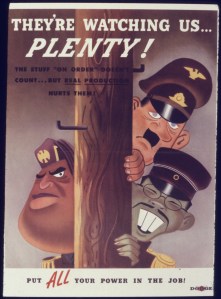
The Second World War was a battle for civilization– a no-holds-barred fight to the death, during which all rules of civilized behavior were broken, by all sides. This was reflected in the propaganda.

wwIIpropposter

Comic books were a big part of this– including “Superman,” fighting for truth, justice, and the American Way.

supermanwwII

STAN LEE AND JACK KIRBY

The two great creators of Marvel characters and storylines during its formative years were both New York City natives who fought in World War II. Both firmly bought into Franklin Roosevelt’s ethos of America saving the world. Given the nightmarish regimes on the other side of the oceans, this was an understandable, even necessary viewpoint.

Kirby and Lee retained this ethos after the war. (Evidence suggests that Stan Lee retains it now.) In the 1960’s they launched “Sgt. Fury and His Howling Commandos,” refighting the same battles.

Sgt_Fury_Vol_1_78

NOT that this was unusual– Germans continued as cartoonish villains across the culture, from movies to television shows to professional wrestling, which featured arrogant Nazi bad guys such as the nasty “Baron Von Raschke.”

baron2

ALL’S FAIR in love and war, as they say, even when the war’s long over. Or even when it’s a Cold War. So, while Sylvester Stallone fought cartoonish Russian movie monsters like Ivan Drago–

drago

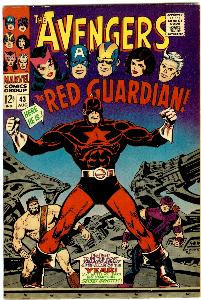
— Marvel’s Captain America battled his Soviet nemesis, Red Guardian.

Avengers-43

The question can legitimately be asked: When were superhero comic books not outright propaganda for Pax Americana– usually of the most jingoistic variety?

MANY of Marvel’s recent superhero movies– the “Captain America” and “Iron Man” series come quickly to mind– have continued this mindset. Always with a global, America-running-the-world mindset. One “Iron Man” flick had the character outdoing drone missiles in blowing up bad guys in Afghanistan. (See this Noah Berlatsky review of it.)

new pop lit's new blog

THE SURPRISE is that today’s social justice warriors in the comic book realm, ostensibly on the left, use these precedents as justification for their political aesthetic now.

(It could just be that “left” and “right” are obsolete concepts for truly understanding today’s world.)

CONTRADICTIONS

When dealing with issues like fascism and anti-fascism, one will always run into a host of contradictions. A good example is recently deceased award-winning novelist Philip Roth. Roth’s 2004 novel, The Plot Against America, depicts a world in which Charles Lindbergh has become U.S. President and imposed a fascist-like regime, with Franklin D. Roosevelt offstage as ostensible good guy. Kind of a misguided slant on history, in that Lindbergh was politically inept and non-interventionist. The contradiction is that FDR himself came closer to being a dictator than any President before or since. Elected for four terms; hyper-devious and charismatic; a popular demagogue; knew how to use media, particularly radio; built America’s military-industrial complex and empowered giant corporations in order to do so; put an unpopular ethnic group into concentration camps; tried many maneuvers to get around the U.S. Constitution; etc. etc.

THIS was the offstage ideologue and ideology which comics creators like Stan Lee and Jack Kirby explicitly followed– a worldwide American interventionist viewpoint.

TODAY

The big comic book companies today have a different agenda– or are pandering to a different agenda. As before, the goal is some level of social engineering– real life masters of the universe deciding from above what the brave new world should look like. Art usually gets lost in the process, and always has.

ART AND PROPAGANDA

CAN art be polemical and at the same time, important art?

THAT Frank Norris’s populist novel The Octopus, and Ayn Rand’s The Fountainhead— the first from the left, the other from the right– are both polemical, yet two of the best American novels ever written, says the answer to the question is “Yes.” But there are lines to be crossed. (Rand crossed them herself in her next major work.)

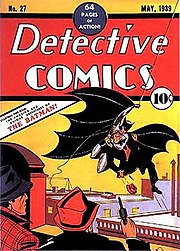
In this critic’s opinion, two major comic book superhero series have crossed into the realm of important, even mythic, art: “Batman” and “Spiderman.” Most of the rest have either been harmless entertainment or indoctrination pamphlets.

180px-Detective_Comics_27

-Karl Wenclas


New Pop Lit’s K.M.C. at WC3!

Wayne_County_Community_College_District_Downriver_Campus_Taylor_Michigan

HEADS-UP that New Pop Lit Contributing Editor Kathleen Marie Crane will be speaking this Thursday, May 24, at Wayne County Community College’s downriver campus in Taylor, Michigan as part of an “Images of Resilience” exhibit. The topic: Recovery. The event will take place at the Heinz Prechter Arts Center. Reception at 6 p.m., storytelling event to begin at 7 p.m. Other featured speakers include marathoner Matt Lockwood and former NFL quarterback Eric Hipple, with NPR’s Shannon Cason as emcee. Don’t miss it!

Address: 21000 Northline Road, Taylor, Michigan.

kathimagesofresilience - Edited

(K.M.C. with the other featured speakers.)

Marxism Inc. Part Two

HOW KARL MARX GOT IT WRONG

Ford_Rouge_Plant_-_panoramio

THE REAL CONFLICT in societies is tops-down monopolies versus upstart insurgencies pushing new ideas or better ways of doing things. If you will, Big Business versus small. Communism in practice is another style of monopoly– a particularly pernicious one, ultimately run by status quo control freaks. The idea for them is always to grab power. Once it’s achieved, it’s difficult (once thought impossible) to get them out.

(The difference was exemplified in the Soviet Union in the conflict between Mikhail Sholokhov, a system apparatchik, and Alexander Solzhenitsyn, who brought his ideas and writings from below– from the gulag!– intending to change the system Sholokhov defended and from which he was its conforming product.)

One can see why closet totalitarians, and conformist writers, as well as global capitalists, are attracted to Communist ideology.

In this Olivia Goldhill article at Quartz magazine we see typical establishment-intellectual infatuation with Marxism. Goldhill can barely restrain her gushing. For her, Karl Marx predicted “exactly” how capitalism would turn out.

Well, Marx did, in unpublished journal entries in a notebook, speculate about automation eliminating jobs. Certainly not a unique thought throughout the first stages of the industrial revolution. (We have the example of the chess-playing automaton known as “The Turk,” created way back in 1770!)

It’s those notebook entries themselves which should concern Ms. Goldhill and other Marxist acolytes. Seems more to be evidence of dawning concerns in Marx’s mind that his labor value theory might be a crock. If there’s no “living” labor, where’s the oppression? From where comes the value?

Olivia Goldhill discusses the seeming “contradiction” within capitalism when it eliminates human labor– but the contradiction is within Marx’s ideas. There appears to be contradiction only because the labor value theory is wrong.

(There are other reasons for capitalism appearing to be in continual crisis– chiefly that it’s like a living organism, one continually self-adjusting, always remaking itself.)

Actual value comes not from labor– from exertion whether human or machine based– but from ideas behind the labor. Value comes from the creators– which can be shown throughout the history of capitalism. How much value did the mind of Thomas Edison add to economies throughout the world? Henry Ford? Steven Jobs?

From where came the value in a Vincent van Gogh painting? From his paintbrush??!

paintbrushes

Do we calculate the value in how much time he spent at the canvas? In how much energy he expended upon the brush??

For the artist– the writer included– Marx’s theory is ludicrous.
****

Karl Marx can be applauded within his historical context. For being the first to create an all-encompassing examination of economies during the capitalist era– an era we continue to live in. But it was a primitive examination. Classify Marx with a D.W. Griffith, who pioneered the art of the film– yet who has to be put within context, not treated as a gospel writer relevant to how things operate now.

-Karl Wenclas

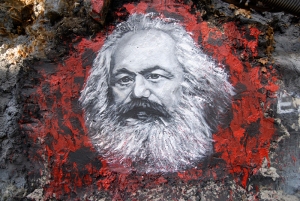
Karl_Marx,_painted_portrait_DDC2787

Marxism Incorporated

HOW MARXISM TODAY IS A WHOLLY-OWNED SUBSIDIARY OF BIG MONEY

marxstatue

First of Two Parts

MUCH CELEBRATION has taken place in recent days of the May 5th, 2018 200th birthday of Communism advocate and theorist Karl Marx. Typical of the press this occasion has received is this article by Olivia Goldhill at Quartz magazine.

WHO owns Quartz?

Laurene Powell Jobs, one of the richest capitalists on the planet. In July 2017 her curiously-named Emerson Collective bought The Atlantic and its digital properties, one of which is Quartz. Ms. Jobs apparently doesn’t see Marxism as any kind of threat to her well-sheltered wealth, or to herself. (Quartz in fact recently published another Goldhill-penned tome joking about Marx’s co-optation by capitalists.)

In 2018 the espousal of Marxism comes chiefly from plutocrats– and from hugely-rich centers of power and influence like Harvard. I previously examined here Marxist intellectual journals The Baffler and Current Affairs, the former owned by a billionaire; the latter founded by Harvard student Nathan J. Robinson, son of an international corporate trainer. Olivia Goldhill, coincidentally, is herself a Harvard grad.

So what’s actually happening?

WHAT MIGHT BE HAPPENING is that Monopoly Capitalism seeks to set the current hierarchy rigidly in place. This would explain much, as I’ll discuss in a future post.

WHAT MIGHT BE HAPPENING is a Shigalovian strategy, as outlined in Fyodor Dostoevsky’s novel The Possessed. A Ten Percent class of enlightened socialist overlords (Harvard grads?) managing the rest of the human herd for the good of all.

WHAT MIGHT BE HAPPENING is that Laurene Powell Jobs and Company see Marxism as a way to channel dissent, directing it toward ideas and programs amenable to the maintenance of Global Capitalism.

Or: Marxism today is a scam.
*******

NEXT: The Goldhill Essay Itself.

-Karl Wenclas

Classic Incel

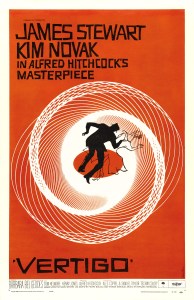
Vertigomovie

CURIOUSLY, the best movie about the incel (involuntarily celibate) phenomenon is sixty years old– Alfred Hitchcock‘s classic, Vertigo. The lead character, Scottie Ferguson, played by James Stewart, is obsessed with the wife (Kim Novak) of industrialist Gavin Elster (Tom Helmore). I don’t want to give away a complex plot. I’ll just say that Gavin is the successful alpha male juggling women, while Scottie is a troubled loner on the outside, searching for unattainable perfection which he can never have.

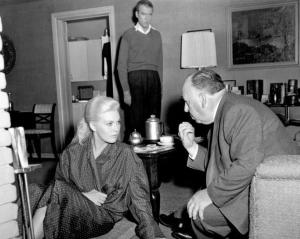
novak-stewart-hitchcock-vertigo

Director Alfred Hitchcock himself was something of an incel, though married– continually crushing on impossibly unreachable actresses like Grace Kelly and Tippi Hedren. Living vicariously through his films– Vertigo revealing much.

Vertigo1

Emma Gonzalez’s Curious Connections

THE MOTHER LODE OF CONSPIRACY THEORIES?

datacenter

EVERYONE KNOWS Parkland student David Hogg is the son of a former FBI agent. One can figure Dad has advised young David each step of the way during the remarkable movement which has sprung from the tragedy at Marjory Stoneman Douglas High School.

But what about the other face of the student movement, Emma Gonzalez? Does her father have ties, past or present, to the U.S. intelligence community?

He does.

joseg

Emma’s father, Jose E. Gonzalez, is the CEO of Trapezoid Inc., a Miami-based digital security firm. One of Trapezoid’s chief partners is DigitalEra Inc. Mr. Gonzalez was recently named to DigitalEra’s board of directors, along with James Cason. See this:

https://www.prnewswire.com/news-releases/digitalera-group-appoints-james-cason-jose-gonzalez-to-its-board-300494494.html

James Cason has an interesting biography:

“Cason spent 38 years as a Foreign Service Officer for the US State Department, serving in 12 countries. He’s been the Ambassador to Paraguay and Chief of Mission in Havana, Cuba.  Cason has received numerous awards from State, Defense, the White House and the intelligence community.”

Before founding Trapezoid, Jose E. Gonzalez worked for DigitalEra, helping them expand into “managed information security services.”

Among its other tasks, DigitalEra tracks “key security events,” including hacker conventions like DEF CON in Las Vegas– an event, according to DigitalEra, regularly attended by Federal law enforcement agents.

Another major investor in Trapezoid is CoVant Management Inc., based in McLean, Virginia. CoVant invests in the federal government technology services industry. Meaning, in firms which do business with the federal government.

TERREMARK

terremark

Jose E. Gonzalez’s most interesting employment was from 2000 to 2007 with the now-defunct Terremark Inc., where he worked as its Chief Legal Officer, then as Senior Vice-President.

Founder, and CEO when Gonzalez worked there, was Manuel D. Medina. Born in Cuba, Medina left that country with his parents in 1965, at age 13, “because of the extensive political changes in the country” per wikipedia.

JAMIE DOS SANTOS

jamiedossantos

In 2001, Medina hired Jamie Dos Santos to oversee the transition of Terremark from a real estate firm to a security firm. She became CEO and President of subsidiary Terremark Federal Group, which was based not in Miami but in Herndon, Virginia. Its objective was to secure government security contracts– which were in abundance following 9-11.

Ms. Dos Santos has been involved in a number of similar corporations, during her time at Terremark and afterward. One example is the Armed Forces Communications and Electronics Association, incorporated in 2003 with Dos Santos as Director. It’s currently inactive.

A noteworthy incorporation which took place after her Terremark time was the curiously-named Isis Defense Corporation in McLean, Virginia (less than a mile away from the Department of Homeland Security), created in 2013 with Jamie Dos Santos as President and CEO, and still active.

In 2014 Jamie Dos Santos was appointed as a Member of President Obama’s Intelligence Advisory Board. Currently Dos Santos is the CEO of Cybraics Inc., which uses Artificial Intelligence to enhance security– presumably for business and government.

It’s not known how close a business or personal relationship Jose E. Gonzalez has with Jamie Dos Santos– other than they’re both prominent in the government-business security field and both worked in important positions at the same time for the same company.

MORE TERREMARK

Exactly how big and powerful Terremark was in the government-security field is evidenced by this analysis of why Verizon purchased Terremark Worldwide Inc. in 2011.

18028_Verizon-Brooklin

Verizon-Terremark was given the enormous government contract to run the healthcare.gov website, which infamously crashed late 2013. This fiasco led to the end of Terremark, whose data centers were sold to Equinix Inc. for $3.6 billion.

ARTHUR L. MONEY

Another past Terremark employee of note is Arthur L. Money, on its board and a strategic advisor to Terremark on homeland security affairs from 2003 to 2011. Money has played huge roles in the government-business security relationship, including as the Assistant Secretary of Defense under Bill Clinton, and later as first chairman of the FBI‘s Science and Technology Advisory Board under George W. Bush.

Arthur L. Money has been on the board of too many security firms to count. One example is the Paladin Capital Group, set up three months after 9-11 specifically to capitalize on federal investments in security after the terrorist attacks.

CONCLUSIONS

Jose E. Gonzalez, father of Parkland survivor student activist Emma Gonzalez, is an expert on security, and has direct connections to several of the most important players in the government security field. It’s highly ironic that the two most important Parkland activists have fathers who were or are in that field. When the shooting at Marjory Stoneman Douglas High School took place, all their expertise went for naught– despite numerous warnings about the shooter given to police agencies and the FBI.

THIS commentator doesn’t believe there was any advance conspiracy to stage the shooting, or even to allow it to take place. It’d be absurd to think parents would purposely allow their children in the vicinity of that kind of danger. However, it’s logical to believe the parents would do everything they could after the tragedy to transfer focus away from the failure of police agencies like the Federal Bureau of Investigation to act on the many advance warnings.

What some see as conspiracy, NPL News sees (despite the many observed connections) as simple government incompetence.

-K.W.

(Be sure to read the other interesting posts on this blog– and check out our main site, New Pop Lit.)

Alpha Male Wannabes

baboon

THE LATEST NEWS among the established intellectual community is they’re all in a frenzy over renegade professor Jordan Peterson, who’s begun to follow his own thoughts and ideas– independently!– and has left the politically-correct intellectual reservation.

AND SO, every intellectual pretender has penned his-or-her own takedown of the guy, the latest coming from Current Affairs head editor Nathan J. Robinson, whose own project we profiled recently. As in, last week. (See my last two posts.)

LIKE his colleague Briahna Joy Gray’s essay on rock n roll history and cultural appropriation, Robinson’s is skewed and from a narrow viewpoint. Also like her essay (see this) it misses the real story.

It’s by his essay’s one-sidedness that Robinson gives his own game away.

Noteworthy about Nathan J. Robinson is his lack of self-knowledge. He seems to live in a bubble-world constructed of his own role-playing. In his complaints about white males and the patriarchy, he doesn’t notice that he’s a white male, and Current Affairs is a patriarchy.

What bothers Robinson most about fellow academic, fellow Anglo-Saxon Jordan Peterson? That Peterson has the #1 book on virtually all best-seller lists! Robinson mentions this pointedly. Jordan B. Peterson (not he, Nathan J. Robinson) is at the top of the intellectual hierarchy. The alpha male of that scene. And so, Robinson attacks him vociferously.

Jordan Peterson, a Jungian psychologist, must be amused by the attack– as well as what wannabe Robinson misses in Peterson’s ideas. Jordan Peterson is essentially right– that behind our masks we’re brutal animals. Much of our communication and most of our behavior can be explained by subconscious forces which, often against our will, drive us. Nathan Robinson acts this out in his posturing with his magazine.

And yes, Jordan Peterson is right that without the strictures and controls of civilization, relations would return to a more primal reality. Notice what occurs at stray times when civilization leaves. One recent example is the end of World War II in Europe, when Patton’s army moved east and a horde of German women moved west, giving themselves to American G.I.’s to avoid the more brutal celebrations of the New Soviet Man coming from the east. Little acknowledged but able to be found in dusty military histories, or in anecdotes from American vets, is that the end of the war was a rape fest. A reversion to type?

A Jungian would notice monsters of the Id. Those we try to wipe away, like Dr. Morbius confronting his Id near the end of the 50’s sci-fi classic “Forbidden Planet.”

fplanet110

***

The Jungian would notice hidden forces in Brooklyn hipsters, wearing long beards and lumberjack shirts, markers of masculinization, as their subconscious minds rebel against their own socially-compelled feminization.

hipster

***

What then of Nathan J. Robinson, who usually appears clean-shaven? Deliberately nerdy and harmless. How does he fit this analysis?

One could surmise the harmlessness is merely a mask, obscuring the ruthless being– the alpha male wannabe– lurking beneath.

-K.W.

Who’s Appropriating Whom?

Sun_Studio

AS DISCUSSED in our previous News blog post, Current Affairs magazine and other “hard left” periodicals are staffed by well-educated cultural aristocrats appropriating the voice and stance of leftist radicals.

Yet we find to our surprise that Current Affairs published an article by Briahna Joy Gray about the very subject of cultural appropriation! It’s here.

NOT surprising is that the essay presents the Harvard tops-down viewpoint, and is filled with distortions.

New Pop Lit‘s editor (me) is writing a series of posts at his personal blog addressing the Current Affairs essay’s viewpoint. The pieces are being written in reverse order. The second one is “All About Chuck Berry.” The third and concluding part of the series is “All About ‘Hound Dog.'” The opening salvo is upcoming.
*******

ABOUT APPROPRIATION

The charge of so-called cultural appropriation, applied to rock n roll history– coming from of all places Harvard University; home of the Elite of the Elite– seems to this commentator designed to shut down (and wipe history books clean) of small-scale business run by street hustlers. IF the culture of the 1950’s had worried about matters of appropriation, that would’ve been the result– and rock and roll would never have happened. Including England’s Beatles, who did their share of appropriation, of artists black and white, and of every possible style, including Broadway show tunes and 1920’s English music hall ditties.

(My series is showing that during the rise of rock music, everybody was freely appropriating everybody– with one of Ms. Gray’s chief victims, Chuck Berry, as one of the appropriators.)

motown

THE PROBLEM with the tops-down Harvard Viewpoint is that it eliminates artistic diversity, integration, mutation, choice, and change under the guise of doing the opposite. Without such appropriations by low-rent wannabe-capitalist scramblers trying to make a buck, the music industry would’ve remained as static and uninteresting as the literary scene is today; dominated by unknowing conglomerate machines and Ivy League-dominated foundations understanding only one way of viewing the art; one safe way of thinking, writing, promoting and publishing.

-Karl Wenclas