Are you concerned about a flood of A.I.-generated books and articles dumped on the already-too-competitive publishing scene?
Established authors will have nothing to worry about. Neither will the well-connected Manhattan/Ivy League crowd. But what about the rest of us– those independent Do-It-Yourself writers, like ourselves, who have books on Amazon or elsewhere to sell?
Right now there are many hundreds of thousands of writers scrambling for notice (along with more than 1600 literary outfits like ours). A market already divided into micro-niches will be divided into further niches, as the number of “authors” looks to multiply several times over. Business’s long-tail effect stretching ever longer.
At minimum, there needs to be proper labeling on literary products, so readers readily know what they’re getting.
Ergo, our Petition, advocating for information statements on A.I.-created books.
Please click, read and consider signing! Also, please feel free to offer feedback or pushback, by adding a comment below.
(As we say, we’re not against technology– it’s inevitable– we want transparency. There undoubtedly are many in the tech industry and outside it who will want to purchase A.I.-created books. Labeling will make their task easier.)
THE BIG NEWS in the publishing world revolves around science fiction magazine Clarksworld closing submissions after being swamped with ChatGPT-created short stories– an increase over three months from under 25 to over 500.
In other news, a spate of A.I.-generated books have already begun to hit the market, per this article from Reuters.
OR: disruption of the publishing industry has taken place much more swiftly than anticipated. We at New Pop Lit have attempted to be open-minded regarding the new technology. It’s usually futile to fight progress, or what’s marketed as progress. The new technology has undeniable benefits for the individual writer, in speed and ease of writing. We also believed that using it more astutely than others might be a way to take on publishing’s Big Five, who are slow at adapting to anything. (Much of their way of operating is lodged in the early 20th Century, if not the 19th.)
However, techies themselves have decided to become major players in writing and publishing. Here’s a Tweet from the founder and CEO of OpenAI, the company which has inflicted ChatGPT and Dall-E upon the world: the two A.I. devices most directly aimed at the literary world.
writing a really great prompt for a chatbot persona is an amazingly high-leverage skill and an early example of programming in a little bit of natural language
Keep in mind that Sam Altman, like his technology colleagues and peers, is utterly ruthless. Who were the other original investors in OpenAI when it began business in 2015? Reid Hoffman, Jessica Livingston, Elon Musk, Ilya Sutskever, Peter Thiel: billionaires all, almost a Who’s Who of technology venture capitalists and entrepreneurs. (Corporate investors included Amazon Web Services.)
Elon Musk is the most well-known of the bunch (Peter Thiel perhaps the most infamous). These are people who have their interests and money invested in everything.
Over the past few years I’ve been researching Musk, reading every book I could find on him. Why? Because he’s disrupting the automotive industry. Being from Detroit, I’ve worked in an auto plant, and have friends and relatives in the automobile business. As do most people in this area.
Elon Musk exemplifies the mindset. Move into a vulnerable field and with new technology and aggressive tactics– including hyperbolic salesmanship– take it over. These are not preppy Ivy Leaguers taking casual three-martini Manhattan lunches and dawdling over the perks of upper-level publishing. An entirely different animal is entering the literary arena.
Technology for these people isn’t a job or a game– it’s a religion. They want it all: spaceships to Mars, A.I. robots, eternal life: everything. They won’t stop until the science fiction world of their fantasies is reality.
THE IMPACT
In the meantime, what’s the impact on the cozy world of letters? Publications large and small, online and print, will be overwhelmed with submissions, as anyone who ever had a vague thought of becoming a writer can now create a manuscript in minutes with a few prompts. It may become difficult to tell real from fake. A culture which already has too many writers will see their number multiplied– which will make it that much greater a task for any of us to stand out from the mass. Connections to the right people– already a determining factor– will become even more important. Who you know and who you suck up to. Got a book you want to market? Good luck!
There may be solutions or ways to overcome the obstacles, but the odds against have increased.
A RECENT Substack essay by cultural historian Ted Gioia, “The State of the Culture (2023),” has received a level of attention on social media the past two weeks. It’s an interesting analysis of the dilemma the arts face at the moment, where there’s far too many choices, too much supply for static demand. As Gioia states: “The metrics for our culture have never been. . . well, they’ve never been larger.” And: “Our culture is one of abundance and instantaneous gratification . . . Never before has so much culture been available to so many at such little cost.” The problem amid this abundance, Gioia says– for literature in particular– is a dwindling audience.
In his analysis of the situation Ted Gioia is undeniably right. He’s also right that the demand for writing– for books and literature– needs to greatly expand. Where’s he’s wrong is in his prescription for how to accomplish that.
His tried-and-failed solution is education. More and better education! “– let’s focus our efforts on creating a discerning audience for these offerings.” Audience development and institutional outreach– geared toward bringing good writing (and music and painting) to the masses instead of the usual large conglomerate offerings of generic pop music, big-budget CGI Marvel movies, and predictably bland mass market genre fiction.
The problem with Ted Gioia’s solution is it doesn’t work. Music education has been a part of public schools for at least seventy years. Billions have been spent by nonprofits and universities on training skilled new musicians while promoting appreciation of the art. You want outreach? A huge portion of any major orchestra’s budget is spent on outreach, through education programs in schools and at the orchestra’s facilities itself. I’ve worked as a salesman for a major orchestra (and other arts organizations), and part of my job was simple outreach. Letting the public know this art was there.
What’s been the result? Classical music, which circa 1955 accounted for 20% of the record-buying market, is currently down to 1%. Jazz, Broadway cast albums, and other forms of “serious” music are faring no better.
The situation is little different for literature. Despite hundreds of writing programs throughout the country churning out many thousands of well-trained writers, the literary art has never been more culturally marginalized and socially irrelevant than now. The Big Five book conglomerates don’t have a clue how to excite the general public, and neither do college professors and literary critics, most of whom bemoan the decline of “serious reading.”
THE SOLUTION
The preferred solution, in our eyes, is a completely revamped art, which the New Pop Lit project is about. Creating new kinds of short stories (once the most popular American art form), which can grab the reader from the first lines and never let go, and at the same time, be topical and relevant and maybe polemical but in all aspects engaged with the world and the lives of those who aren’t reading much of anything. This will include more striking-looking print vehicles than books with their predictably-formatted black-and-white texts accompanying linear single-viewpoint narratives. We’ve put forth some prototypes of alternatives, available at our POP SHOP.
The solution is all-new art, unlike anything yet seen, which demands to be bought. Art which can create true excitement among a lethargic, jaded public.
Is this possible? The music industry of the past offers a road map: the consolidation of strands of roots music into rock n roll, which via pure energy burst big-time onto the American cultural scene in the mid-1950s and pushed all other offerings to the sidelines. Rock was a demand-centered phenomenon, as record sales multiplied several times over during a twenty-year period, and vibrant music became an indispensable part of everyday life.
Could a similar cultural earthquake happen in the sleepy world of letters? If it can be imagined it can happen.
The sudden emergence of the ChatGPT Artificial Intelligence device has raised a host of questions about what effect it will have on writers, and on literature itself.
To attempt to plot out where we’re headed, one has to look at both extremes of reaction– not just to A.I., but to the contemporary world itself.
TRUE BELIEVERS
Over the past thirty years new technology has become a religion. Its entrepreneurs and advocates see it as a solution to all problems– and are blind to its many downsides. On social media, apologists for A.I. and for everything digital are everywhere. For them, the Internet IS the world.
In the arena of art and letters, the thrust of their arguments is that A.I. allows greater, or at least easier, creativity. Much time is spent defending against accusations of plagiarism and copyright violations– which are not the biggest issues with A.I. technology.
THE REFUSAL-TO-CHANGE CROWD
At the other extreme are writers and literary critics who can’t conceive of any change to the refined literary art they know and love. Their essays overflow bemoaning the dwindling status of “serious reading,” as they look back fondly at past “avant-garde” innovators such as Virginia Woolf, now safely dead.
How will they react to an invasion of ChatGPT novels into an already-saturated publishing market?
One can expect they not only won’t attempt to use the device (well, some of them will if the wind blows strongly in that direction), they also won’t try to change the art to put it more in step with a changing world– as a way to ward off the A.I. threat. Instead they’ll retreat further into their bunker and their canons of the past. In this instance, classical music is the model for what will happen.
THE FUTURE
What are the real pros and cons of A.I. technology applied to writing and literature? What’s the best strategy to follow: to embrace the technology, or find ways to defend against it? I’ll address these questions in a future post.
WITH CHRISTMAS and the other holidays upon us, we plan to finish the year with a campaign of pure happiness. Well needed when everyone seems stressed out and beaten down from the craziness of the world around us.
Our antidote to the harshness of the world comes in the form of a simple print publication: a Special Edition of our latest zeen, Fun Pop Poetry. Amazing words and colors to brighten up anyone’s day– from artists Monica Morgan and Alexandria Root, and poets Blixa Bel Grande, Scott Cannon, Emerson Dameron, Wred Fright, Courtenay Schembri Gray, Craig Kurtz, Christopher Landrum, Dan Nielsen, John D. Robinson, Joe Santi aka Tarzana Joe, Chrissi Sepe, Ellsworth B. Smith, Richard Stevenson, and S.F. Wright.
That’s a lot of talent in one slim and artsy poetry booklet!
Order your smile at our POP SHOP— red cover or yellow. Do it for yourself, (or purchase two and give one as a gift).
WHERE are we all of us– editors, writers, readers– headed as a literary community? An artistic community?
These are questions that will be addressed during our one-hour appearance at the Trenton Veterans Memorial Library, 2790 Westfield Road in Trenton, Michigan, for National Novel Writing Month aka NaNoWriMo. New Pop Lit editors Karl Wenclas and Kathleen M. Crane will be prepared to discuss all things literary.
THIS COMING SATURDAY, November 19, beginning at 2 pm.
OUR CURRENT feature story, “True Survivor” by Greg Jenkins, is a good example of how a short story can be artistically successful by following– unintentionally or not– techniques used to find success in the music business.
Foremost among them is the story’s opening, which does two things done by the famed British pop group the Beatles and others in order to stand out from the musical crowd.
1.) THE ATTENTION-GETTER
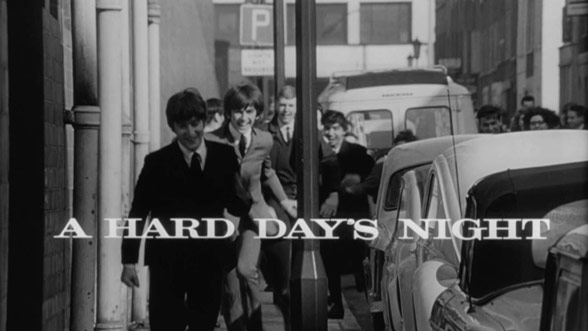
First, the attention-getting first note. First done by Ludwig van Beethoven to open his Third Symphony. A more recent example is the opening chord to “A Hard Day’s Night,” the title song to the Beatles’ first film. Think of how it must’ve sounded coming from large speakers in a movie theater, accompanied on a giant screen by an image of the four young musicians being chased down a Liverpool street. Attention: caught.
Greg Jenkins does the same thing with his story’s opening sentence, consisting of a single word, each letter capitalized: “SULLIVAN!”
2.) START WITH THE CHORUS
The second technique used by the Beatles was to in effect start the story with the chorus. Or, if it were fiction, in the middle of the narrative. Like opening in the middle of a song.
A famous example of this is one of the rock group’s first hits, “She Loves You.”
Which ensures opening with a bang. The Beatles did this again at least one other time, with similar success, with “Can’t Buy Me Love.”
What’s the goal? To grab the listener– or reader– by the collar, lift the person out of his or her chair and not let go until the artistic experience is over. Part of the creation of Beatlemania involved hitting the record buyer with immediate energy.
With a different art form, Greg Jenkins starts his story in the middle of the action, then goes back to explain what led to the conflict. (Jack London does the same thing with his classic short story, “Lost Face.”)
MORE POP
The most extreme musical example of this technique came a bit later in the frenzied history of the so-called British Invasion of America, in 1965, when Herman’s Hermits had a Number One hit by eliminating a song’s verses altogether– to a 1911 music hall ditty, “I’m Henry the Eighth, I Am”– and singing only the chorus, repeated three times. The result was not exactly artistic, but it was effective with the intended audience.
Could this be done with the short story– taking technique one step beyond? Stripping down a tale to its barest essentials and depending upon pure pop energy and enthusiasm to carry it?
We don’t know, but in our New Pop Lit LABS we’re not above trying every trick possible in our quest to reinvent literary forms, and in so doing enliven literature itself.
We also look for writers, like Greg Jenkins, who use innovative techniques. Know any others? Send them our way!
NEW POP LIT‘S Editor Karl Wenclas made a recent appearance on the estimable Contra Mundum Media podcast, which is dedicated to exploring new ideas in the culture and the arts. The host of the podcast is Christopher Laurence.
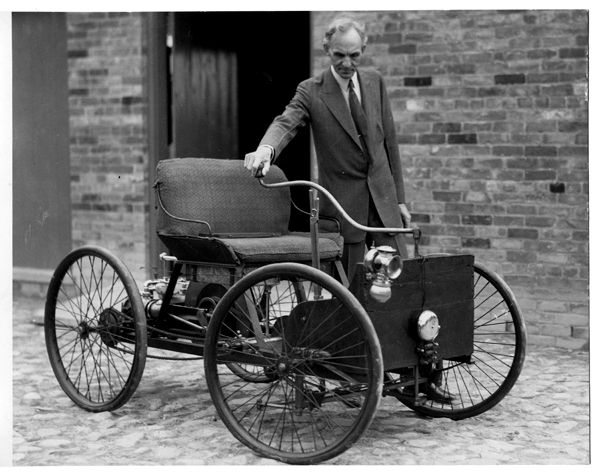
ONE OF the first steps in creating the New is development of a prototype. That which can hint at innovations to come. As Henry Ford did with his first prototype, an automobile constructed largely from bicycle parts.
A prototype is a demonstration model intended to serve two purposes:
1.) To show potentials of the design or concept.
2.) To reveal flaws when ideas become reality.
By definition a prototype is not a finished product, or the ultimate expression of the intended product. But it should point a direction– a new path for creators to follow.
Prototype of first Tesla Roadster c/o Tesla Motors.
We’ve developed prototypes of new kinds of literary journals (see them here). But we’re also working on what we call the multidimensional or “3-D” short story.
One of the simpler ones we’ve released to date is “The Perfect Candidate.” Note how the opening is intentionally disorienting– the idea to disorient readers then quickly reorient them. (“Where am I? Who’s speaking?”) The narrative in this one is linear– but the changing viewpoints allows the writer to hint at what he wants, obscure what he wants, and reveal what he wants.
The story is designed-– as designed as a modernist skyscraper or the layout of a glossy New York magazine. The goal: a more rounded version of reality. The idea behind this story, this prototype, is to point to the endless possibilities of the well-designed story.
THE NEXT STEP is looking upon the short story– or the nonfiction essay– as part of an entire aesthetic.
THE CHALLENGE
The objective is to put the literary world into a state of flux, where change becomes constant– the only way to diminish the built-in advantages of an institutionalized, monopolistic status quo. Then– to stand out among the innovators.
Timing is key, as it was for Henry Ford. No one remembers the other tinkerers and pioneer automobile innovators, the other hundred-or-so fledgling car companies in the first couple decades of the Twentieth Century.
No one will remember this project unless we achieve artistic breakthrough.













 newpoplitnews.com